Choose timezone
Your profile timezone:
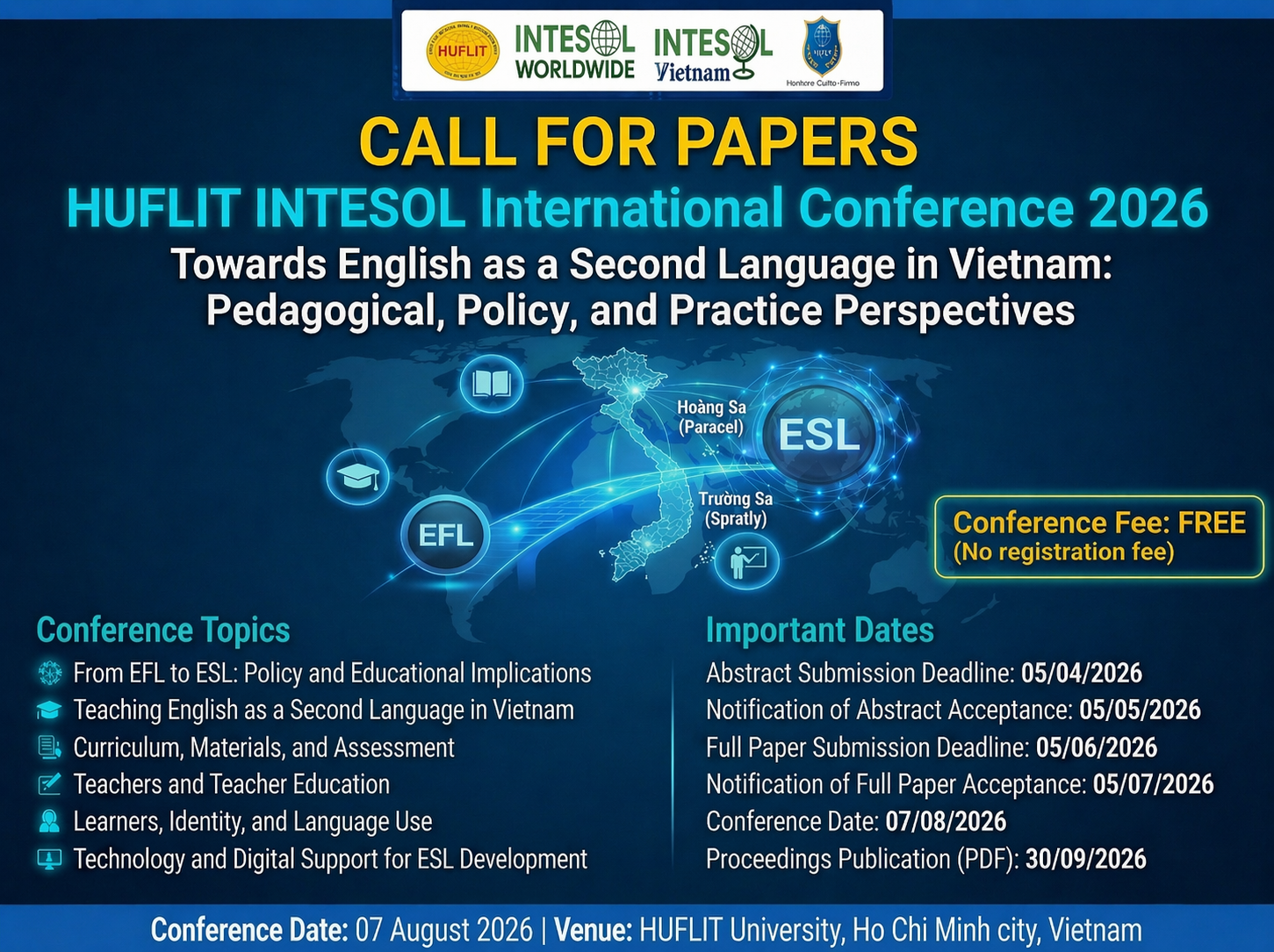
📍 Venue: Ho Chi Minh City, Vietnam
📅 Conference Date: 07 August 2026
💰 Conference Fee: FREE (No registration fee)
🏛 Organizers: HUFLIT & INTESOL Vietnam
🕒 Timezone: Asia/Ho_Chi_Minh
* Registration deadline: July 15, 2026 (Link)
Vietnam is entering a critical stage in its language education development, with English increasingly positioned not merely as a foreign language, but as a second language for education, employment, and international engagement.
The HUFLIT INTESOL Conference 2026 provides an academic and professional forum to examine what it truly means to move from English as a Foreign Language (EFL) to English as a Second Language (ESL) in the Vietnamese context.
This transition raises fundamental questions about curriculum design, teaching methodology, assessment practices, teacher education, learner identity, language policy, and classroom realities across educational levels.
The conference welcomes researchers, teacher educators, practitioners, policymakers, and graduate students to critically explore how English can be taught, learned, assessed, and lived as a second language in Vietnam and comparable ESL-emerging contexts.
Participation in the conference is free of charge, supporting inclusive and nationwide academic exchange.
Towards English as a Second Language in Vietnam:
Pedagogical, Policy, and Practice Perspectives
| Submission Type | Length |
|---|---|
| Full Research Papers | 4,000–6,000 words |
| Short Papers / Work-in-Progress Reports | 2,000–3,500 words |
| Practical Workshops / Teaching Demonstrations | 1,000-word proposal |
| Poster Presentations | 300–500-word abstract |
All submissions should clearly relate to the transition toward ESL in Vietnam or comparable contexts and provide theoretical insight, empirical evidence, or pedagogical innovation.
The HUFLIT INTESOL Conference 2026 addresses a pivotal moment in Vietnam’s language education landscape as English increasingly functions as a second language essential for academic engagement, professional mobility, and global integration.
The conference bridges policy directions, empirical research, and classroom practice, fostering dialogue that is theoretically grounded and responsive to real educational contexts.
As a free academic conference, HUFLIT INTESOL 2026 ensures inclusive access for educators and researchers nationwide. Jointly organized by HUFLIT and INTESOL Vietnam, the conference reflects a shared commitment to advancing high-quality, research-informed English language education in Vietnam.
Click "Submit new abstract" (or the relevant Indico button) to participate in HUFLIT INTESOL 2026.
Vietnam is undergoing a major change in English language education, moving from the traditional model of English as a Foreign Language toward a more communicative English as a Second Language orientation. This keynote explores how debate-based pedagogy can help learners use English more confidently, think critically, examine evidence, and respond meaningfully to different viewpoints. By integrating classroom debates into English teaching, the presentation highlights practical ways to strengthen communication, engagement, and critical thinking in Vietnamese classrooms.
Rooms B56 and B57 are available for participants who wish to rest during the lunch break.
Most of the English-major sophomores of the 63th course of Nha Trang University make mistakes in grammar, spelling, vocabulary and ideas in business writing. To improve their writing skills, sophomores of the experiment class were asked to do a service-learning project to assist freshmen in writing academic paragraphs. Service-learning method is a teaching method which links classroom learning knowledge with skills and knowledge gained through volunteering to support the community in reaching sustainable development goals. This paper aims to discover students’ attitudes towards service-learning project and see if this project can help to improve students’ business writing skills. The research targeted the population of 113 students, including 82 sophomores of the 63th course (41 students of the experiment class and 41 students of the traditional class) and 31 students of the 64th course. Qualitative methods (personal interviews) and quantitative methods (online survey, comparison of the final papers) were utilized in this paper. Research results showed that the service-learning project improved the students’ business writing skills, and developed other soft skills such as communication skills, organization and planning, teamwork, analysis and synthesis, information searching and familiarity with information technology.
This study evaluates the effectiveness of the English Language training program at Ho Chi Minh City University of Foreign Languages and Information Technology (HUFLIT) through an outcome-based education (OBE) perspective, focusing on the alignment between Program Learning Outcomes (PLOs) and the Common European Framework of Reference for Languages (CEFR). Adopting a mixed-methods approach, the study combines quantitative analysis of student achievement data and survey responses with qualitative insights from instructors to examine the extent to which program outcomes are achieved. The findings indicate a generally strong alignment between PLOs and CEFR descriptors, particularly in core language skills, suggesting that the program effectively supports students’ language development in line with intended learning outcomes. However, certain discrepancies are observed in higher-order communicative competencies, highlighting areas for further curriculum refinement. The study offers practical implications for curriculum design, assessment practices, and quality assurance in English language programs within higher education, contributing empirical evidence to ongoing discussions on outcome-based program evaluation.
The proliferation of ChatGPT has facilitated the learning of translation subjects among language learners, and this is especially true when Vietnam aims to transition English from EFL to ESL. The omnipresence of the chatbot in translation courses proves its effectiveness in assisting learners to achieve their academic targets; nevertheless, the factors behind students’ decision to employ the tool seem to have been inadequately explored. This paper aims to investigate the determinants of the employment of ChatGPT in translation among English-majored students. The study involved 103 students of English in their second and third years at Ho Chi Minh City University of Foreign Languages - Information Technology (HUFLIT) utilizing a mixed-methods approach. The findings suggest that perceived usefulness, perceived ease of use, perceived risks of ChatGPT employment, intrinsic and extrinsic motivation, as well as social influence stand out to be pivotal factors in students’ decision to adopt ChatGPT in their translation assignments. The study also places an emphasis on the equipment of students with essential linguistic knowledge, post-editing competencies, and higher-order thinking skills to effectively utilize ChatGPT for translation subjects while simultaneously encouraging lecturers to make transformations or adaptations in translation pedagogy, drawing students’ attention to meaning- and context-oriented translation, fostering interactivity, critical translation and comprehension skills, and ethical awareness of adopting ChatGPT in classroom activities to be aligned with the national orientation of making English become a second language rather than a foreign one.
Key words: factors, employment of ChatGPT, translation, ESL orientation
In higher education, AI tools are increasingly used to support idea generation, content organization, language improvement, and presentation design. However, despite this growing use, limited research has focused specifically on how students employ AI in developing academic presentations and how they perceive its benefits and challenges. This study aims to investigate students’ use of AI in presentation development, with particular attention to their patterns of use, perceived usefulness, perceived ease of use, behavioral intention, and concerns related to critical thinking and academic transparency.
This study employed a quantitative survey design. Data were collected through a questionnaire administered to undergraduate students who had experience using AI tools to prepare academic presentations. The questionnaire explored students’ demographic background, prior experience with AI, frequency of use, purposes for using AI, preferred tools, estimated level of dependence on AI, and their perceptions across key attitudinal dimensions. Descriptive statistical analysis was used to identify major trends and patterns in the responses.
The findings indicate that AI has become a regular support tool in students’ presentation preparation. Students reported using AI most frequently for brainstorming ideas, organizing content, paraphrasing, improving grammar, and increasing efficiency. Overall, the participants expressed positive perceptions of AI’s usefulness and ease of use, and many showed a strong intention to continue using AI in future presentation tasks. At the same time, the results reveal important concerns. Some students reported uncertainty about disclosing AI use and acknowledging AI support appropriately, while others indicated possible risks related to overreliance and reduced critical engagement.
Understanding how learners’ motivation translates into actual language use beyond the classroom remains an important issue in TESOL research. Drawing on the L2 Motivational Self System proposed by Zoltán Dörnyei and the sociological perspective of linguistic capital developed by Pierre Bourdieu, this study examines how English-majored university students’ motivational self-concepts and perceptions of the economic value of English relate to their engagement with English outside formal learning contexts.
A mixed-methods design was employed. Quantitative data were collected through a survey measuring six constructs: perceived economic value of English, ideal L2 self, ought-to L2 self, and three forms of English use beyond the classroom (academic, social, and habitual). Reliability analysis indicated excellent internal consistency across all scales (α = .91–.95). Exploratory factor analysis supported a six-factor structure explaining 82% of the variance (KMO = .97). Structural equation modeling further revealed that motivational self strongly predicted English engagement beyond the classroom (β = .97, p < .001). Social and habitual English use emerged as the strongest indicators of engagement, whereas academic English use contributed less strongly.
To complement the survey findings, semi-structured interviews will be conducted with ten English-majored students to explore how they perceive the role of English in their academic, social, and future professional lives. The findings suggest that fostering learners’ future-oriented identities may help TESOL practitioners encourage meaningful language engagement beyond the classroom.
Teacher oral feedback plays a crucial role in supporting learners’ speaking development, particularly in high-stakes test preparation contexts. This study investigates learners’ perceptions of teacher oral feedback in VSTEP speaking preparation classes at Lac Hong University, Vietnam. Data were collected from 64 students through a structured questionnaire measuring four dimensions of feedback: clarity, timing, focus, and affective tone. The findings indicate that learners generally hold positive perceptions of teacher oral feedback (Mean = 3.90). Among the dimensions, feedback clarity and focus were rated highest, suggesting that learners value explicit and task-related guidance. In contrast, affective tone received lower ratings, with evaluative feedback negatively associated with learner confidence. Correlation analysis further reveals that clear feedback enhances perceived usefulness, while supportive feedback contributes to increased confidence and willingness to communicate. These findings highlight the importance of balancing instructional clarity and emotional support in speaking feedback practices. Importantly, the study suggests that effective feedback in VSTEP speaking classrooms can serve as a pedagogical bridge toward ESL-oriented instruction, fostering communicative competence beyond test preparation. The study contributes to current discussions on language teaching in Vietnam, where English is increasingly positioned as a second language.
Keywords: VSTEP; oral feedback; learner perceptions; speaking skills; ESL-oriented instruction
Abstract
Generative AI (GenAI) has transformed higher education, particularly in English Language Studies. However, GenAI is most effective when it helps students build on their own thinking. Accordingly, this study investigates the perceptions and self-reflection practices of English-majored students regarding the use of GenAI in their academic journey. Utilizing a structured self-reflection checklist, the research explores how students balance GenAI assistance with independent thinking across four key domains: academic problem-solving, creative expression, communication, and decision-making. A mixed-methods research design was employed, using questionaries to collect quantitative data and reflective journals and semi structured interviews to collect qualitative data. Data were collected from 50 English majored students at Binh Duong University - Ca Mau Campus. Preliminary findings indicated that while GenAI is widely used for drafting and refining ideas, there is a significant need for developing strategic autonomy to prevent creative emptiness and over-reliance. The study emphasizes the role of self-reflection as a pedagogical tool to foster ethical and effective AI integration in English Language Studies.
Keywords: GenAI, self-reflection, English majors, learner autonomy, academic integrity.
The integration of Artificial Intelligence (AI) tools in language learning has sparked interest in their potential use in supporting the improvement of speaking skills, especially in high-stakes tests such as IELTS. However, research about how learners perceive the usefulness of AI-generated feedback in IELTS Speaking Part 3 practice remains limited. Therefore, this study employed a qualitative approach to explore students’ perceptions of using ChatGPT for IELTS Speaking Part 3 practice. Semi-structured interviews were conducted with eight English-major undergraduates with IELTS band scores ranging from 5.5 to 6.5 who had experience using ChatGPT to practice IELTS speaking part 3 and receive feedback. Both positive and negative perceptions were revealed using qualitative data analysis. On the one hand, ChatGPT was perceived as useful in providing a secure environment to practice speaking, giving immediate feedback, expanding lexical and grammatical resources, and improving the organization, cohesion, and coherence of the speech. On the other hand, participants reported drawbacks in speech recognition and prompt quality. Such limitations were found to influence learners’ trust in the system and shape their overall perception of its usefulness. The findings indicate potential applications of ChatGPT in facilitating IELTS Speaking Part 3 practice and, at the same time, highlight the need to provide training or guidance on creating efficient prompts and follow-ups, as well as to raise learners’ awareness of critical evaluation of AI-generated responses.
With globalization increasing the demand for proficient business communication, it is crucial to equip ESL learners with the vital skills to thrive in professional environments. Business Communication is a compulsory subject in the training program for the Business English major, Faculty of Foreign Languages at Ho Chi Minh City University of Foreign Languages and Information Technology. Various teaching methods and innovative forms of on-going assessments for students have been continually applied to enhance their interest and motivation in learning, helping them achieve the course objectives as well as practice important skills to meet the increasing demands of the labor market. This study examines the significance of the course from the students’ perspective as well as the impacts of various teaching methods and evaluations, including role-playing, case studies, AI-enhanced learning tools and presentations on learners' communication proficiency. Data collected from surveys and classroom observations provide insights into the effectiveness of different teaching approaches.
Business Communication, teaching methods, evaluations, impacts
This study investigates the effectiveness of AI-powered game-based activities implemented through Blooket in enhancing vocabulary retention and motivation among young EFL learners in a private English center in Ho Chi Minh City, Vietnam. Adopting a mixed-methods quasi-experimental design, the study involved 82 A2-level learners aged 10–11, including an experimental group receiving Blooket-based vocabulary instruction and a control group receiving traditional instruction. Quantitative data were collected through vocabulary pre-tests and post-tests, while qualitative and supportive data were obtained from a questionnaire, semi-structured interviews, and classroom observations. The findings indicate that the use of Blooket had a significant positive effect on learners’ vocabulary retention and classroom motivation. Students in the experimental group showed clear improvement in post-test performance and reported that the platform made vocabulary learning more enjoyable, interactive, and engaging. The results also suggest that Blooket promoted greater participation, confidence, and willingness to review vocabulary, although some learners experienced difficulty with fast-paced game modes. For TESOL, the study highlights the pedagogical value of integrating AI-powered game-based tools into vocabulary instruction, particularly for young learners in EFL contexts where motivation and repeated exposure are essential for language development.
Keywords: AI-powered, game-based learning, Blooket, vocabulary retention, learner motivation, young EFL learners
Despite years of mandatory instruction, many Vietnamese university graduates remain unable to communicate effectively in English, a failure largely attributable to the entrenched dominance of the Grammar-Translation method. This paper argues that the path to genuine fluency lies in the rigorous application of the Direct Method in teaching English to speakers of other languages (TESOL), moving beyond structural analysis to total linguistic immersion. We examine the cognitive interference caused by first language (L1) dependency, demonstrating how mental translation inhibits the development of spontaneous speech and listening reflexes. The study proposes a practical framework for implementing the Direct Method in the modern Vietnamese classroom, emphasizing the exclusive use of the target language, inductive grammar instruction, and the development of strategic competence through intensive question-and-answer exchanges. Furthermore, we explore how digital transformation – specifically through Learning Management Systems (LMS) and gamified platforms – serves as a critical enabler of this method, providing the objective, high-frequency input necessary to bypass the safety bias inherent in traditional grading. By shifting the pedagogical focus from linguistic knowledge to communicative performance, this approach not only aligns with the biological reality of language acquisition but also empowers educators to evaluate students based on their actual proficiency rather than administrative caution.
Keywords: Direct Method, Higher Education in Vietnam, Communicative competence, LMS, TESOL
ABSTRACT
This TESOL paper explore how to create an English-rich learning environment beyond the classroom to improve university students’ speaking ability and overall communicative competence. Grounded in key theories of second language acquisition, learners’affective factors, and task-based language learning, the study emphasizes the role of out-of-class exposure in strengthening learners’opportunties to use English for real communication. It also analyzes typical chalenges in the university context, including limited speaking practice, anxiety, and low willingness to communicate.Based on the theoretical foundation and situational analysis, the paper proposes practical solutions for students, learning groups/clubs, and universities. These solutions focus on designing structured yet psychologically safe speaking tasks, integrating feedback mechanisms, and extendingEnglish use into meaningful contexts such as peer interaction, community engagement, and other out-of-class learning channels. The paper concludes that an English-rich environment beyond classroom activities can effectively support learners in transforming input knowledge into communicative output, thereby building confidence and sustainable speaking development.
Keywords: English-rich environment, beyond classroom, out-of-class learning, willingness to communicate, speaking development
In today’s globalized world, developing intercultural competence has become an essential goal of language education. This presentation explores how connected classrooms can support the development of intercultural communicative competence (ICC) among English as a Foreign Language (EFL) learners. Through digital technologies and online collaboration platforms, students can interact with peers from different cultural backgrounds, allowing them to experience authentic intercultural communication beyond traditional classroom boundaries.
The study presents practical classroom practices in which students participate in virtual exchanges, collaborative projects, and cross-cultural discussions with partner classes. These activities encourage learners to compare cultural perspectives, reflect on their own cultural identities, and develop empathy and global awareness while improving their English communication skills. The presentation also highlights the role of teachers in designing meaningful tasks, facilitating intercultural dialogue, and guiding reflective learning.
Preliminary observations suggest that connected classroom activities can significantly enhance students’ motivation, cultural awareness, and communicative confidence. However, challenges such as technological access, time coordination, and teacher readiness must also be addressed. The presentation offers practical recommendations for integrating connected classroom practices into EFL teaching to promote intercultural learning in meaningful and sustainable ways.
The ongoing digital transformation in higher education has exposed limitations in traditional self-study practices at Vietnam Aviation Academy (VAA), particularly as self-directed learning accounts for up to 30% of course assessment. In General English courses, paper-based homework frequently results in delayed feedback, increased administrative workload for instructors, and low levels of student engagement. Despite national efforts to promote Industry 4.0 integration in Vietnamese higher education, homework and self-study activities at many universities in general and VAA in personal remain largely manual and insufficiently aligned with digital learning environments.
To address challenges, the author needs streamlined digital tools that support rather than complicate the learning process. This study investigates the integration of Testmoz as a solution to modernize formative assessment. The research aim is to clarify if digitizing these practices from designing Testmoz assignment can able to not only provide students with more timely feedback but also reduce the daily workload for instructors. By implementing and evaluating Testmoz at the Vietnam Aviation Academy (VAA), the research also hopes to provide a practical roadmap for using digital tools to improve student outcomes in the Vietnamese higher education context.
Keywords: digital transformation, testmoz, assessment, feedback
Submission type: Abstract for Short Paper (2000-3500 words)
The transition from English as a Foreign Language (EFL) to English as a Second Language (ESL) in Vietnam necessitates a critical reconsideration of assessment practices in English Language Teaching. One emerging trend is the rise of “no-exam” or assessment-light classrooms, which challenge the dominance of traditional summative testing.
Conventional exams, while valued for standardization, often demonstrate limited construct validity in capturing communicative competence. They tend to privilege discrete linguistic knowledge and performance under pressure, rather than the ability to use language meaningfully in real contexts. In contrast, no-exam approaches conceptualize assessment as an ongoing, evidence-based process embedded in interaction, feedback, and reflection, aligning more closely with sociocultural and constructivist views of learning.
However, this shift raises important concerns regarding reliability, comparability, teacher workload, and institutional accountability. In exam-oriented contexts, the removal of formal testing structures may also challenge entrenched educational expectations.
This review argues not for the elimination of assessment, but for its reconceptualization. In an ESL-oriented environment, valid assessment should reflect language as a dynamic, socially situated practice, supported by multiple forms of evidence rather than a single high-stakes test.
Keywords: esl transition, language assessment, no-exam classroom, tesol
This study examines the institutional transition from English as a Foreign Language (EFL) to English as a Second Language (ESL) in emerging Southeast Asian higher education contexts. Focusing on the Academy of Policy and Development (Vietnam), Stamford International University (Thailand), and Philippine Normal University (Philippines), the research addresses how institutional English language policies facilitate this shift and which cross-institutional practices most effectively enhance English-mediated employability and academic mobility. Using a comparative, qualitative-dominant mixed-methods design, data were collected through policy document analysis, semi-structured interviews, and student surveys. Findings reveal that the EFL–ESL transition is incremental and policy-driven, relying on coherent alignment across curriculum reform, English-medium instruction, assessment practices, and industry engagement. Institutions demonstrating higher policy coherence report stronger employability and mobility outcomes. The study contributes empirical evidence to language policy and higher education research by identifying transferable institutional mechanisms that operationalize ESL-oriented reforms in emerging contexts, offering practical guidance for policymakers and university leaders seeking workforce-relevant English education strategies.
Abstract
This paper aims to expand previous investigations into the pedagogical application of artificial intelligence (AI) in translation studies by synthesizing empirical survey data on students’ use of AI in Theories and Methods of Transinterpretation (TMT) exercises with an instructional design framework for composing Vietnamese–English structural translation tasks, which are hopefully brought a new atmosphere to further motivate students. Drawing on classroom-based evidence collected from 68 undergraduate students and an applied methodological model developed at HUFLIT, the study proposes a comprehensive, AI-assisted pedagogy that balances automation with human editorial control. The findings demonstrate that AI-enhanced structural translation exercises can significantly improve student motivation, engagement, and perceived competence, provided that instructors actively curate linguistic structures, vocabulary domains, and contextual complexity. The paper contributes a scalable instructional model, a validated exercise-design workflow, and pedagogical implications for translation programs in comparable EFL contexts.
Keywords: structural translation, transinterpretation, learning motivation, Vietnamese–English translation, TMT
AI tools such as ChatGPT have radically transformed the teaching and learning processes. While ChatGPT is widely used, its impacts on learners’ confidence and capabilities are concerning. Therefore, this research aims to examine the relationship between translation-majored students’ ChatGPT usage patterns and their reported translating self-efficacy. Fifty-five students majoring in Translation were involved in a three-part survey which includes questions on demographic information, common ChatGPT usage patterns in doing translation tasks, and the self-efficacy levels adapted from the Translating Self-Efficacy Scale (TSE-C). Differences in translating self-efficacy among groups of users with different ChatGPT usage patterns were analyzed using one-way ANOVA, followed by Tukey’s post-hoc tests for pairwise comparisons. The findings reveal higher confidence among students using ChatGPT to analyze and plan their translation tasks compared to those who used ChatGPT for drafting translations. The study results inform lecturers’ instructional design, thus guiding students to effectively use AI tools and develop self-efficacy in translating tasks.
Keywords: ChatGPT, ChatGPT usage patterns, translating self-efficacy
A persistent challenge in Vietnamese EFL education is the gap between classroom learning and real-world communication. Many non-English major students perform well on grammar tests but struggle to understand natural speech or engage in spontaneous conversation. Meanwhile, these students frequently consume short-form video content on platforms like TikTok and Reels, much of which features authentic, unscripted English. This study explores whether this daily habit can be leveraged as a pedagogical tool. This pilot study investigates the use of curated short-form videos to improve listening comprehension and speaking confidence among second-year, non-English major students at Hùng Vương University (CEFR A2 level). Over eight weeks, approximately 30 students will engage with videos depicting real-life scenarios—ordering food, casual conversations, and everyday transactions. Classroom activities include shadowing for pronunciation, learning colloquial expressions, role-plays, and student-created videos to reduce speaking anxiety. Using a pretest-posttest design, the study combines listening and speaking assessments, questionnaires on communication confidence, and focus group interviews. Expected outcomes include improved ability to decode natural speech and increased willingness to communicate. Positive findings would offer Vietnamese EFL teachers a low-cost, engaging method to enhance communicative competence using familiar digital platforms. This pilot provides foundational insights for future research and curriculum development at Hùng Vương University and beyond.
Keywords: short-form videos, TikTok, listening skills, speaking skills, A2 level, EFL, authentic materials, willingness to communicate
With the trend of English as a second language (ESL) as a major priority in Vietnam, students in universities are expected to use English in addition to the classroom more frequently than before. However, in a country that encourages widespread adoption of digital learning tools, this phenomenon may remain a hurdle as they tend to have difficulty in real-life ESL applications, leading to a significant discrepancy between what they learn and actual language use. Most previous studies have been concerned with learner motivation and attitudes, paying limited attention to the question of how AI-assisted learning environments mediate in students’ readiness to learn ESL. The purpose of this study was to investigate Vietnamese university students’ ESL readiness and investigate the effect of AI-supported learning on this readiness. We employed a mixed-methods design, incorporating survey data available from 70 university students as well as semi-structured interviews with 10 participants. Student engagement, self-directed learning, and use of English beyond the classroom were examined in this study. Quantitative data was analyzed using descriptive and inferential statistics and qualitative data were analysed thematically. A report on this survey found that this AI-driven learning experience increased student engagement and increased real-life English use, but the communicative competencies of the same students varied. This indicates that once implemented into pedagogy, AI can promote ESL readiness. This research needs context-sensitive utilization of AI in Vietnamese higher education.
This study explores the application of the PEEL/PETAL framework to enhance paragraph writing skills for Grade 10 students using the Global Success curriculum. Addressing common challenges such as fragmented ideas and lack of coherence in Vietnamese EFL classrooms, the initiative was implemented during the 2025–2026 academic year. Methodologically, the research employed a mixed-methods approach, including pre- and post-writing tasks, observations, and student questionnaires. Key pedagogical interventions involved model analysis, guided planning with scaffolds, and peer feedback integrated into diverse writing genres. Results indicate significant improvements in students’ logical organization, evidence integration, and cohesive linking. Furthermore, the framework notably boosted learners' writing confidence. The findings suggest that PEEL/PETAL serves as a practical, scalable scaffold for developing structured writing skills in secondary EFL contexts, offering valuable insights for teachers navigating the new national curriculum requirements.
Keywords: PEEL, PETAL, paragraph writing, EFL classroom, Grade 10, Global Success
This study examines how artificial intelligence (AI) is being researched and perceived in English language education among English-major students at HUFLIT in Ho Chi Minh City, Vietnam. It has two main aims: to map the research methods currently used to investigate AI in English language education and to explore students’ attitudes toward AI-supported learning. Adopting a mixed-methods design, the study first conducts a systematic review of recent institutional and classroom-based projects on AI in English teaching and learning at HUFLIT, identifying predominant methodological choices, data collection instruments, and analytical approaches. Building on these findings, a questionnaire survey is administered to English majors to investigate their perceived benefits, challenges, and ethical concerns regarding AI tools in language learning, followed by semi-structured interviews with a subset of participants to gain deeper qualitative insights. The results are expected to reveal patterns in how AI-related research is conceptualized methodologically, as well as how students negotiate issues such as autonomy, academic integrity, and trust in AI-generated feedback. The study aims to inform more rigorous research design in AI-in-education projects and to provide evidence-based recommendations for integrating AI into English language curricula at HUFLIT and similar Vietnamese universities.
Keywords: artificial intelligence, English language education, research methods, student perceptions
This study examines how institutional visions, policies, and pedagogical realities shape ESL competence development in Vietnamese higher education through a case study at Phenikaa University and Hanoi Metropolitan University. Amid national shifts from EFL toward functional ESL models driven by globalization and EMI expansion, persistent gaps remain between policy intentions and classroom practices. Employing a mixed-methods case study design, the research integrates policy analysis, surveys, and semi-structured interviews with administrators, lecturers, and undergraduates across EMI, EAP, and ESP programs. Findings indicate that clear institutional visions and explicit policy guidance support stronger alignment with communicative ESL outcomes, particularly within EAP contexts. However, large class sizes, assessment misalignment, heavy workloads, and limited English-rich environments constrain effective implementation, especially in EMI programs. The study contributes context-sensitive empirical evidence on how governance, pedagogy, and environment interact in ESL development, offering practical implications for institutional reform and sustainable language education policy in Vietnam.
This study investigates how English teachers in a Vietnamese educational context respond to emerging ESL-oriented expectations. Although recent reforms emphasize communicative English teaching, limited research has examined how teachers interpret such expectations before they are formally implemented. The study aims to explore teachers’ perceptions of ESL-oriented expectations and how these shape their professional identity and agency. It also examines the challenges teachers anticipate and their projected responses to these changes. A qualitative research design was employed, using semi-structured interviews with eight English teachers across different educational levels. The data were analyzed thematically to identify patterns in teachers’ interpretations, anticipated challenges, and projected actions. The findings show that teachers associate ESL-oriented expectations with communicative teaching and real-life language use, while experiencing uncertainty due to the lack of clear guidance. They anticipate shifting from knowledge transmitters to facilitators of communication, but foresee tensions related to exam-oriented systems, large class sizes, and uneven student proficiency. Although teachers express willingness to adapt, their agency is shaped and constrained by structural conditions and limited institutional support. The study highlights that teacher identity and agency are constructed not only through enacted policy but also through anticipated expectations, emphasizing the need for coherent support in educational transition contexts.
Keywords: teacher identity, professional agency, ESL-oriented expectations, educational change, Vietnam
Speaking anxiety continues to constrain learners' participation and oral performance in English-as-a-Foreign-Language (EFL) classrooms. Although recent work has examined the use of artificial intelligence (AI) in language learning, its role in addressing affective factors remains insufficiently investigated. This study examines the effects of AI-mediated low-stakes practice on speaking anxiety among Vietnamese university students. A quasi-experimental design was implemented with two intact classes of 64 second-year English-majored students at a Vietnamese university. The experimental group engaged in AI-supported speaking activities, including guided role-plays and repeated practice using conversational AI tools over a six-week period, while the control group followed conventional speaking instruction. Data were collected through pre- and post-tests using a speaking anxiety questionnaire adapted from the Foreign Language Classroom Anxiety Scale (FLCAS) and an analytic speaking rubric. The results indicate that students in the experimental group reported significantly lower levels of speaking anxiety and higher levels of confidence compared to those in the control group. Student feedback further suggests that AI-mediated practice enabled repeated, low-pressure exposure and reduced concerns about negative evaluation. The findings provide empirical support for the integration of AI-mediated low-stakes activities in speaking instruction as a means of addressing affective constraints and supporting learner participation in EFL contexts.
Keywords: AI-mediated learning, speaking anxiety, low-stakes practice, EFL classrooms, quasi-experimental design
The transition toward English as a Second Language (ESL) education in emerging economies such as Vietnam has necessitated a fundamental shift from traditional summative assessment to more dynamic, classroom-based alternative assessment (CBA) approaches. Despite increasing pedagogical advocacy for formative, peer, and performance-based assessment, empirical evidence on how these approaches influence communicative competence and student engagement remains limited, particularly in ESL transition contexts. Drawing upon social constructivist theory and experiential learning perspectives, this study develops and tests a research model examining the relationships among classroom-based alternative assessment (formative assessment, peer assessment, and portfolio-based assessment), student engagement, and communicative competence. A quantitative research design was employed using survey data collected from 412 undergraduate students enrolled in English-related courses in Ho Chi Minh City, Vietnam. The proposed model was analyzed using Partial Least Squares Structural Equation Modeling (PLS-SEM), complemented by Artificial Neural Network (ANN) analysis to capture nonlinear effects. The results reveal that alternative assessment practices significantly enhance student engagement, which in turn positively influences communicative competence. Among assessment dimensions, formative assessment and peer assessment exhibit the strongest effects. The mediating role of engagement is also confirmed. The findings contribute to the ESL literature by extending classroom-based assessment theory into emerging contexts and by empirically validating a learner-centered assessment model. Practical implications highlight the importance of integrating alternative assessment strategies to foster authentic language use and engagement in ESL classrooms.
In the context of digital transformation, instructors’ digital competence has become a crucial factor affecting teaching quality and students’ learning experience. Digital competence is not simply a capability of using technology, but it also includes integrating digital tools to design lessons, evaluate, provide feedback, and support learning effectively. However, feedback practice and personalized learning are still a research gap, especially in university education; both lecturers and students need to adapt to digital technology. The study aims to discover the effect of digital competence on students’ feedback and personalized learning. The quantitative approach with a cross-sectional survey design is mainly applied to this study, including observation, document analysis, and a questionnaire. Data collection is done through the questionnaire, measuring three main variables: instructors’ digital competence, feedback quality, and personalized learning level. Especially, the data analysis is based on the SEM model (SmartPLS4) to test research hypotheses and evaluate the relationship among variables. The expected results show the positive effect of digital competence on feedback effectiveness and personalized learning. Instructors with good capabilities of using technology can integrate digital tools to provide in-time feedback, transparency, and flexibility to meet learning needs. Effective feedback, which can strongly promote autonomous learning by supporting students with self-regulated strategies, is the intermediary element between digital competence and personalized learning. The study significantly contributes to developing professional training programs for instructors, establishing a theoretical foundation of digital competence, creating a flexible learning environment with a student-centered approach, and providing positive feedback to meet students’ learning needs effectively.
The use of Artificial Intelligence among students in their learning process has been attracting significant attention and investigation. The current study, accordingly, is an attempt to delve into the use of AI tools among first-year English majors to deeper understand the role of these tools in their essay writing process and the perceived effects on students’ English writing skills. Data obtained from 60 questionnaires revealed that AI tools, ChatGPT and Google Gemini in particular, have become an integral part of the students in their essay writing across all stages, among which vocabulary, grammar, and ideas assistance are highly appreciated. Though the students are hesitant about whether they are over-relying on these tools, they generally believe that AI does help improve their English writing skills on the long term. However, from the researcher’s classroom observation, the students’ excessive reliance on these tools during their essay writing process can be seen, especially among those with low-English proficiency. Therefore, further research should clarify the use and effects of AI tools among students of different levels of English to ensure that these tools can actually be their effective study companions.
Keywords: Artificial Intelligence, first-year, English majors, essay writing
Abstract
This study evaluates the efficacy of integrating Total Quality Management (TQM) into Service-Learning projects to fulfill University Social Responsibility (USR) and facilitate the transition from English as a Foreign Language (EFL) to a simulated English as a Second Language (ESL) environment. In provincial higher education institutions, executing USR is frequently constrained by limited resources, while learners lack authentic language practice environments.
An empirical study is designed at Pham Van Dong University, involving the entire cohort of third- and fourth-year pre-service English teachers. To optimize resource allocation, the research applies the TQM’s PDCA (Plan-Do-Check-Act) cycle and internal quality control criteria to design, operate, and evaluate community-based teaching projects. Data are anticipated to be collected utilizing teaching portfolios, pre- and post-intervention professional agency scales, and quantitative local community social impact metrics.
Data analysis is expected to demonstrate a statistically significant increase in pre-service teachers' professional agency post-intervention. Pedagogically, the TQM process is projected to standardize instruction, mitigate deployment risks, and successfully establish a sustainable micro-ESL space.
The findings will provide an empirical foundation for provincial higher education institutions to synchronize USR objectives with language transition policies through rigorous quality management.
Keywords: University social responsibility; EFL-ESL transition; service-learning; total quality management; pre-service teachers.
Dictation has long been recognized as an effective method for improving ESL learners’ listening comprehension. With the rise of web-based applications, learning English has become more accessible and engaging. However, the abundance of dictation websites can pose challenges for both teachers and students in selecting suitable platforms. This study examines the affordances of three popular web-based applications – Dailydictation, English Club, and Parroto – through usability testing focused on site design and user experience. Ten non-English-major university students with mixed levels used the three websites over one week to complete usability testing tasks. Data was collected from users’ journals, and visual analysis. Findings highlight the importance of clear information, and effective interaction design in supporting language learning. Students demonstrated self-directed learning, frequently practicing listening and benefiting from technological features such as personalized suggestions, engaging activities, timely feedback, and error correction. The study underscores the potential of online applications to enhance listening comprehension and offers implications for designing more effective online language learning tools.
Keywords: dictation, web-based learning, listening, usability testing
Abstract: Today, in the field of Vietnam's software engineering, the importance of English proficiency (ESL) in terms of career development and direct client relationships cannot be understated. Currently, it remains a “bottleneck” for Information Technology (IT) students’ graduation and career prospects. In such a context, the rise of Artificial Intelligence (AI) has created both opportunities and challenges. While on one hand, it serves as a powerful support tool, on the other, it is also posing a challenge to students’ learning motivation due to potential over-reliance.
This study examines the impact of using AI tools on students' learning motivation. The research uses a mixed-methods approach, collecting data from surveys and structured interviews with Software Engineering students from HUFLIT university. This helps to see the changes in students’ learning attitudes, digital tool usage behaviors, and learner autonomy that students have in a high education environment.
Our findings can then clarify the relationship between AI integration and students' intrinsic learning motivation. The paper also focuses on developing AI-assisted solutions to boost with proactiveness and self-study capabilities. These solutions aim to present AI not only a tool for learners but also an interactive “friend”. This “friend” can enable software engineering students to personalize their learning paths, boost confidence in real-life communication, and gain advantages in the competitive global labor market.
Keywords: AI-assisted ESL learning, learning motivation, software engineering education, learner autonomy, interactive AI solutions
Abstract
Competency-based reform has reshaped language education, positioning communicative competence as a central curricular goal. In Vietnam, the Competency-Based English Teaching Curriculum (CBETC) embodies this shift; however, its classroom enactment remains theoretically underexamined. Many existing studies often frame implementation as a procedural or belief-driven process, overlooking the systemic and contextual factors that shape teachers’ professional activity. This paper addresses this conceptual gap by proposing Activity Theory (AT) as an analytical lens for examining teachers’ enactment of CBETC. Grounded in Vygotsky’s (1987) sociocultural theory and Engeström’s (2009) third-generation activity system model, the paper conceptualizes enactment as an object-oriented, socially mediated activity constituted by the interaction among subject, tools, rules, community, and the division of labor. Through a theoretical analysis, it explicates how contradictions—particularly between competency-oriented goals and exam-driven structures—shape and constrain teachers’ practices. By advancing a systemic and relational reconceptualization of curriculum enactment, this study contributes to theoretical debates on competency-based reform and provides a conceptual foundation for future empirical research.
Keywords: Activity Theory; curriculum enactment; competency-based education; English language teaching
The transition from English as a Foreign Language (EFL) to ESL-oriented teaching has become an important trend in Vietnamese higher education, aligned with national initiatives such as the project "Ministry of Education and Training of Vietnam’s Project on Transforming English into a Second Language in Schools for the Period 2025–2035, with a Vision to 2045." This shift is driven by the increasing demand for communicative competence and real-world language use. However, it presents challenges for both teachers and learners, particularly in contexts where traditional, form-focused instruction remains dominant. This study employs a mixed-methods case study to explore these challenges in two General English classes (n = 82) at Ho Chi Minh City University of Foreign Languages and Information Technology (HUFLIT). Over a 12-week period, classroom practices were gradually adapted to include communicative and task-based elements. Data were collected through student questionnaires, classroom observations, and teacher reflective notes, ensuring triangulation. Findings reveal that affective factors, especially low confidence and fear of making mistakes, were the main barriers to student participation. Other challenges included dependence on teacher guidance, passive learning habits, and uneven participation in large classes. Nevertheless, targeted strategies such as scaffolding, structured group work, and real-world communicative tasks led to improvements in engagement, interaction, and self-reported confidence. The study highlights the role of teacher agency in mediating pedagogical change and suggests that the transition to ESL-oriented teaching is gradual and context-sensitive, requiring sustained support for both teachers and learners.
Keywords: ESL transition, classroom challenges, Vietnamese learners, task-based learning, case study
Abstract
In recent years, English education in Vietnam has increasingly emphasized communicative competence and the use of English for interaction as the country shifts toward a more ESL-oriented context. However, classroom instruction still largely prioritizes grammatical knowledge and linguistic accuracy over pragmatic aspects of communication. Within communicative competence, the ability to perform speech acts appropriately is essential, as effective interaction requires sensitivity to social context, power relations, and cultural norms. Among speech acts, requests are particularly important due to their variability across languages and their role in managing interpersonal relationships. Despite this significance, instructional approaches to teaching requests remain underexplored in Vietnam.
This study examines how role-play activities can be used to teach the speech act of requests in Vietnamese English communication classes and how they support the development of students’ intercultural pragmatic competence. Adopting a classroom-based case study design, the research involved 41 freshmen enrolled in an English communication course at the Faculty of Foreign Languages, HUFLIT University. Data were collected through classroom observations, recordings of role-play interactions, and students’ task performances, and were analyzed using pragmatic discourse analysis.
The findings show that role-play enhances students’ ability to perform the speech act of requests appropriately across diverse social contexts and provides empirical evidence for integrating pragmatic, interaction-based instruction. These results highlight the significance of role-play as a pedagogically effective approach in facilitating the transition from grammar-focused EFL practices to a more communicative, socially grounded ESL-oriented approach in Vietnam.
Keywords: intercultural pragmatic competence, role-play, speech acts (requests), ESL-oriented pedagogy
Gamified learning tools have attracted considerable interest in language education, especially in the area of vocabulary development. This study explores the effectiveness of Quizizz in improving vocabulary acquisition among freshmen EFL students at HUFLIT. Employing a mixed-methods approach, data were gathered from 100 participants through surveys and questionnaires to explore the influence of Quizizz on students’ motivations, engagements, and vocabulary retention. The results reveal a strong relationship between the use of Quizizz and levels of students’ enthusiasm, participation, and academic achievement. Nevertheless, limitations were noted, including repetitive question formats and the absence of personalized learning pathways. The study recommends incorporating multimedia features, a wider variety of question types, and adaptive learning mechanisms to improve the platform’s effectiveness. The findings emphasize the value of technology-enhanced learning and offer practical insights for learners aiming to optimize digital tools for vocabulary acquisition.
Keywords: Gamified learning, Quizizz, vocabulary acquisition, Freshmen EFL students, technology-enhanced learning, digital tools in education.
This article is an investigation into the challenges encountered by third-year Vietnamese EFL students in English Literature courses and an evaluation of a ChatGPT-assisted pedagogical framework to address such challenges. From the needs analysis of the 122 students at HUFLIT and the pilot program using texts from Jane Eyre (by Charlotte Bronte), the challenges that were identified were linguistic intricacy, cultural unfamiliarity, and procedural uncertainty in reading and analyzing texts. These challenges were not solely attributable to language proficiency but were inherent in literary analysis itself, even among students operating at the B2 and C1 levels. The framework is an eight-step framework that implemented Vygotsky’s Zone of Proximal Development by alternating between AI-assisted and non-AI-assisted activities such as vocabulary analysis, cultural analysis, and formative feedback in analyzing texts and creating written analyses. The pilot showed promising results: 88.5% of students showed increased confidence levels through a survey, and the average rating of the framework’s components was above 4.00 on a 5-point scale. This article is a contribution to the field as it presents a framework that is both practical and theoretically sound and can be used by EFL teachers, curriculum developers and policymakers in Vietnam and other parts of the region.
Keywords: Generative AI in EFL education; literature instruction; close reading; rubric-based assessment; Vietnamese tertiary EFL.
The rapid development of artificial intelligence (AI) technologies has significantly influenced language learning practices worldwide. In recent years, AI-powered tools such as ChatGPT, Grammarly, and other writing assistants have increasingly been used by students to support their English language learning. In the context of Vietnam’s transition toward English as a second language (ESL), understanding how learners perceive and use these technologies has become increasingly important. This study aims to explore Vietnamese university students’ perceptions of artificial intelligence tools in supporting English as a second language learning. The research was conducted among undergraduate students at Ho Chi Minh City University of Foreign Languages and Information Technology (HUFLIT). Data were collected through an online questionnaire distributed to students from January to March 2026. The survey examined students’ patterns of AI tool usage, perceived benefits, and potential challenges when using AI tools for English learning. The findings suggest that most students perceive AI tools as useful resources for improving writing, vocabulary, and grammar, as well as providing immediate feedback during the learning process. However, some students also expressed concerns regarding overreliance on AI and the accuracy of AI-generated responses. The study highlights the potential role of AI as a supportive tool in ESL learning and emphasizes the importance of guiding students to use AI technologies responsibly and effectively in language learning contexts.
Keywords: artificial intelligence, esl learning, student perceptions, educational technology, vietnamese university students
New policies in Vietnam prioritize English, viewing it as the second most important language. Personal motivation plays a crucial role in foreign language learning, a widely acknowledged fact, but most research in Vietnam truly explores what motivates Gen Z students from within. For this study, the author utilized ideas from several different theories, such as Self-Determination Theory, Dörnyei's L2 Autonomous System, Norton's Identity Investment Theory, and MacIntyre et al.'s Communicative Readiness Concept. The author sought to understand what truly motivates 83 Gen Z university students from the College of Foreign Economic Relations in Ho Chi Minh City, Vietnam, through a structured interview with 16 open-ended questions and then analyzed their responses to identify common themes. The author found five main reasons that motivate them internally: learning for pleasure, seeing it as a part of themselves, using digital media for motivation, enjoying self-learning, and a gap between motivation and the actual desire to speak. Internal motivation was always the primary reason they wanted to learn, even in the face of external pressures. The author found that there was often a gap between their motivation and their speaking ability. Even when they had high internal motivation, anxiety about speaking a foreign language still prevented them from actually trying to communicate. These results contradict the common view that Vietnamese students only learn for practical reasons. They show that we need teaching methods and leveraging the habit of using digital technology to help students feel more empowered and confident in communication.
The increasing use of Artificial Intelligence (AI) tools in education has begun to reshape writing instruction in English language learning contexts. However, there is still limited research on how these tools affect English majors in Vietnam, particularly at HUFLIT. This study explores the pedagogical impact of AI tools on the writing skills of third-year English majors at HUFLIT using a mixed-methods approach. Data were collected from a questionnaire completed by 169 students and semi-structured interviews with 8 participants. The findings indicate that many students perceive AI tools as helpful in improving their writing, especially in terms of grammar, vocabulary, and idea organization. Students also reported that AI tools made it easier for them to generate ideas, identify errors, and revise their drafts more effectively. At the same time, some students expressed concerns that relying too much on AI could reduce their ability to think independently and weaken their confidence in writing. Overall, the study suggests that AI tools can support writing development if used appropriately, and it highlights the need for guided and balanced use in teaching and learning.
Keywords: Artificial Intelligence tools, writing skills, English majors, language learning
Task-based Language Teaching plays a central role in recent educational reforms in Vietnam, yet its success hinges on teacher readiness. This qualitative study examines the perspectives of pre-service teachers, an understudied group, to understand how they conceptualize their roles in TBLT and the challenges they expect to face. In-depth semi-structured interviews with ten pre-service EFL teachers at a university in the Mekong Delta were employed and data were analyzed via thematic analysis. The findings show that participants held a well-developed theoretical understanding of TBLT. They viewed their roles as task designers, facilitators, language advisors, assessors, classroom managers, motivators and reflective practitioners. At the same time, they anticipated substantial challenges at three levels: practical limitations in classroom conditions, psychological constraints such as limited confidence, and systemic constraints driven by institutional and assessment pressures. The study concludes that their professional identity remains in a fragile transition, mediated by the conflict between university-taught theories and traditional classroom realities. These findings underscore the urgent need for adaptive TBLT in teacher education and systemic assessment reform to create an enabling environment for communicative innovation in Vietnam.
Keywords: implementation, perspective, pre-service teacher, task-based language teaching, teacher roles.
This study examines the development of research on the application of Appraisal Theory in language education through a bibliometric approach. Appraisal Theory, developed by Martin and White (2005), provides a framework for analyzing how language users express emotions, attitudes, and evaluations. It is grounded in Systemic Functional Linguistics (SFL), an empirically oriented theory that emphasizes the analysis of language in use within authentic contexts (Banks, 2024). Over the past two decades, a growing body of research has explored the pedagogical potential of this framework.
Drawing on articles indexed in Scopus from 2006 to 2026, this study analyzes publications that meet established inclusion criteria using VOSviewer. The analysis focuses on citation and co-citation metrics, bibliographic coupling, and keyword co-occurrence to map publication trends, identify evolving research themes, and highlight influential journals and leading contributors in the field. Accordingly, the study addresses three research questions: (1) How is the academic output on the application of Appraisal Theory into language education characterized in terms of annual publications, journals, and authors? (2) What are the major research themes associated with its application in language education? and (3) What key pedagogical directions have been proposed for ESL teaching? The findings aim to provide a comprehensive overview of the research landscape and to inform future applications of Appraisal Theory in language education.
Artificial Intelligence (AI) has been proved to radically enhance the quality and personalization of language education. Motivated by the growing integration of AI technologies into English learning and the need for research on learners’ perceptions of their effectiveness, this study investigated how tertiary English majors perceived the application of AI-based language learning tools in English speaking self-practice. Employing a quantitative research method, the study was conducted with the participation of 161 students specializing in Aviation English at Vietnam Aviation Academy. Quantitative data on the participants’ perceptions of using AI-powered software for self-regulated English speaking practice were collected using online questionnaires. The results showed that most participants strongly agreed that AI-enhanced resources provided them with personalized learning experiences and real-time feedback. However, they also identified drawbacks, including technical issues and the limited real-life applicability of examples generated by the applications. More importantly, the research detailed specific benefits and limitations of each tool investigated, as perceived by the students. These findings are expected to help any students who wish to improve their English speaking competence choose the AI software that best suits their needs and conditions to achieve their targeted goals in English learning.
Key words: AI tools, English speaking skills, language learning tools, self-regulated
The ability to construct well-supported arguments, address counterarguments, and provide effective refutations is essential in an argumentative essay. Despite increasing access to digital writing support tools, many English-majored students still struggle to produce well-developed argumentative essays. However, there is limited research on how students use ChatGPT to support argumentative writing and how they perceive its effectiveness. This study, therefore, investigates how 10 intermediate-level English majors use ChatGPT to support their argumentative writing through a qualitative design. The qualitative data revealed both positive and negative perspectives. On the one hand, ChatGPT was reported to play a supportive role in helping students strengthen their arguments by offering various argument options with relevant supporting details and evidence when prompted and reprompted correctly, and develop evaluative judgment to assess the effectiveness of the response and research skills to confirm the knowledge. It also supported students during the feedback stage by providing suggestions on language use and explanations of failures related to idea development, cohesion, and coherence in their writing. On the other hand, some students expressed concerns that without a clear understanding of ethical use and underlying cognitive processes, they may become overly reliant on the AI tool. Others reported limited prompting literacy and highlighted the need to develop this strategy to obtain more meaningful responses in a shorter time. These findings suggest that while AI tools can be helpful in improving argumentative writing, students still need guidance and should use them carefully to continue developing their own thinking and writing skills independently.
This study aims to investigate English-major students’ readiness for real-world English use in an ESL-oriented context at HUFLIT University, focusing on three dimensions: communicative competence, willingness to communicate, and L2 self-confidence. Data were collected from 160 English-major students using a questionnaire. Descriptive statistics were employed to examine learners’ overall readiness and their distribution across the three dimensions. In addition, one-way ANOVA was conducted to explore differences in readiness across academic year and self-rated English proficiency, while Pearson correlation analysis was used to examine the relationships among the three dimensions. The findings revealed that students demonstrated a high level of overall readiness toward ESL orientation. While no significant differences were found across academic years, the level of readiness varied significantly according to English proficiency levels. Furthermore, strong positive correlations were identified among the three dimensions. These findings suggest that enhancing learners’ readiness to use English as a second language requires not only the development of language competence but also the fostering of confidence and a supportive environment that encourages active communication.
Keywords: Learner readiness; ESL-oriented context; willingness to communicate; L2 self-confidence
Improving coherence and cohesion (CC) in academic writing, especially for IELTS preparation, is challenging. It requires logical thinking, constructive feedback, and sufficient practice, but time constraints often prevent teachers from properly assessing every student's work. Generative AI models like ChatGPT can be an effective supplementary tool to help students analyse improper cohesive devices and improve the logical flow of ideas. This study examines how 20 students at Industrial University of Ho Chi Minh leverage this tool to enhance CC in their writing. Data was collected through comparing writing samples before and after ChatGPT intervention into the editing and proofreading stage. Both versions of the essays were evaluated using the IELTS writing rubric to identify any positive changes in cohesive devices and idea organisation. Furthermore, interviews and questionnaires were conducted to gather students’ experiences, strategies for using AI-generated feedback, and perceptions of its benefits and limitations. The findings indicate a range of useful prompts for enhancing CC and reveal both advantages and challenges of AI-generated suggestions. This research seeks to provide meaningful insights into the role of generative AI into the writing process, offering implications for English language teaching and learning.
Abstract
In interpreting courses, students are typically expected to engage in independent practice to develop these complex skills. However, many students encounter difficulties in practicing interpreting autonomously. The study examines how AI can facilitate students’ self-practice in interpreting courses. This action research with both qualitative and quantitative methods integrated was conducted with the participation of more than one hundred second-year and third-year students from five interpreting classes at the Faculty of Foreign Languages, HUFLIT. The participants were encouraged to utilize AI tools to support their independent practice outside of the classroom. The findings reveal that the majority of students perceived AI-assisted practice as both useful and engaging while also offering several recommendations for improving its implementation. For more generalizations and pedagogical implications, it is recommended that further large-scale studies should be conducted to examine the effectiveness of AI as a facilitator in self-directed practice for interpreting skills among university students.
Keywords: interpreting courses, self-practice, AI-assisted
Abstract
The growing integration of artificial intelligence (AI) technologies into language learning has transformed opportunities for independent speaking practice in EFL contexts. Despite increasing student engagement with AI-powered platforms, limited empirical research has examined how AI-supported learning relates to learners’ self-regulated learning (SRL) strategies and their speaking self-efficacy. This study explores the relationship between AI-supported SRL and speaking self-efficacy among Vietnamese EFL university students. Adopting a quantitative correlational design, the study surveyed approximately 100 undergraduate students at a private university in Vietnam. AI tools in this study refer to generative AI platforms and AI-powered speaking applications commonly used for idea development, feedback generation, and pronunciation support. Data were collected through two Likert-scale questionnaires measuring students’ engagement in AI-supported SRL strategies (e.g., goal setting, self-monitoring, and self-reflection) and their speaking self-efficacy beliefs. Descriptive statistics, reliability analysis, and Pearson correlation analysis were conducted using SPSS. The findings reveal a significant positive relationship between AI-supported SRL and speaking self-efficacy. Students who demonstrated greater self-regulatory engagement when using AI tools reported stronger confidence in their speaking performance. The study highlights the potential of AI-supported learning environments to foster learner autonomy and enhance psychological readiness for speaking in EFL contexts.
Keywords: Artificial intelligence in language learning; AI-supported self-regulated learning; speaking self-efficacy; EFL higher education; learner autonomy.
In recent years, AI-powered applications in speaking instructions have been growing in popularity due to their interactive features which help engage learners and encourage regular practice. Therefore, many educators have integrated AI tools into their teaching to facilitate instructions and improve learning outcomes. This study investigates the impact of SpeakEasy AI, an AI-powered web application that enables English learners to practice speaking through multiple modes including real-time conversation, simulated tests, and speech audio assessment. A mixed-method experimental design was employed, involving 80 first-year English-major students at Ho Chi Minh City University of Foreign Languages - Information Technology (HUFLIT). The experimental group used SpeakEasy for 10 weeks, while the control group received traditional instructions. Quantitative data were collected through pre-tests, post-tests and questionnaires, and the effectiveness of SpeakEasy AI was compared with conventional teaching methods using statistical analysis. In addition, in-depth interviews were conducted to obtain qualitative insights into students’ experiences and perceptions. The results revealed that the experimental group exhibited significantly greater improvement in fluency and overall speaking competency compared to the control group. Additionally, the experimental group reported positive perceptions of the application’s effectiveness, particularly in reducing anxiety and enhancing speaking confidence. The interview data also indicated additional benefits beyond the enhancement in speaking performance, along with some recommendations to optimize the application. Further research is required to examine its long-term effects across more diverse populations of EFL learners.
Key words: SpeakEasy AI app, AI-powered chatbot, speaking fluency, speaking competency, EFL learners.
This study examines the effectiveness of short-form video platforms as digital tools for English as a Second Language (ESL) vocabulary development among Vietnamese university students. Grounded in multimedia learning theory and micro-learning principles, the study investigates the effects of English exposure, repetition, multimedia elements, and distraction on vocabulary acquisition. A quantitative design was employed, using survey data from 220 students. Data were analyzed through reliability testing, exploratory factor analysis (EFA), multiple regression, and structural equation modeling (SEM). The results show that the model explains a substantial proportion of variance in vocabulary acquisition (Adjusted R² = 0.649). Repetition emerges as the only significant predictor (β = 0.372, p < .001; SEM = 0.549, p = .012), while English exposure, multimedia elements, and distraction are not statistically significant. These findings suggest that repeated exposure, rather than content richness or passive exposure, plays a central role in vocabulary learning. The non-significant effect of distraction further indicates that learners can effectively engage with vocabulary in high-stimulation environments. The study highlights the importance of repetition as a cognitive reinforcement mechanism in short-form video contexts and suggests that platforms such as TikTok and Instagram Reels can support vocabulary learning when designed to promote repeated encounters with target items.
Keywords: short-form video platforms, vocabulary acquisition, repetition, micro-learning, ESL, Vietnam, TikTok, Instagram Reels
Abstract
In today's digital age, the evolutionary development of AI represents an unprecedented information revolution, permeating every industry, especially education, and particularly English language teaching and learning. Alongside, Vietnam's transition of English from a foreign language to a second language has brought about a significant change in teaching and learning. These two simultaneous circumstances are profoundly changing the approach to English learning at all ages, particularly among Vietnamese students, as knowledge about the English language is readily accessible online. Therefore, instructors at the undergraduate level must re-evaluate their teaching methods and find appropriate, engaging, and essential approaches for students’ English language learning. This research is based on an insight into 300 students majoring in English from the Faculty of Foreign Languages at HUFLIT. It aims to explore the requirements and expectations of students regarding English language instructors' teaching methods in the era of AI and English becoming a second language in Vietnam. This study is also to identify the irreplaceable values and capabilities of instructors in English language teaching within the AI integration. The results of this research may help instructors with innovative methods to inspire learners, share experiences and learning pathways, and cultivate students' cultural behavior as well as emotional intelligence when learning and using English.
Keywords: English Language Teaching, ESL Transition, AI Integration, Teacher Roles, Student Expectations
As English language assessment evolves in an increasingly complex and technology-driven landscape, test developers are facing a new generation of challenges—from AI-assisted cheating and deepfakes to designing tasks that are both valid and reflective of real-world communication. At the same time, there is growing pressure to ensure that tests remain fair, reliable, and efficient across diverse learner populations worldwide.
This session explores how these challenges are addressed through innovations in the design of the Enhanced TOEFL iBT (2026). Key areas include the use of multistage adaptive testing to improve measurement precision and test efficiency, principled approaches to item and task design to ensure validity and relevance, and the implementation of advanced at-home security measures, including multi-layered identity verification and live human proctors, supported by advanced AI tools, to ensure both security and test-taker experience.
The session will also discuss how these innovations support fairness across different learner backgrounds while maintaining the integrity of large-scale English assessment. Attendees will gain practical insights into how modern test design balances security, efficiency, and meaningful measurement in today’s global education environment.
Globalization has brought not only opportunities but also challenges to English teaching and learning. In the context of the Mekong Delta, Vietnam, teaching English for non-majored students still faces lots of challenges due to several factors. The present study aims to shed light on factors affecting English non-majored freshmen's language attitude towards EFL learning at Can Tho University of Technology (CTUT). Questionnaires were delivered to 662 English non-majored freshmen, and interviews were conducted with 29 students and 6 English teachers. The results showed that both students and teachers emphasized the significance of EFL learning and teaching in a globalized world. Although the students have acknowledged the importance of the English language, they did not show high motivation in EFL learning. The results also showed that learning materials, lecturers, and peers were positive factors, whereas home learning environment, personality and habits, and interests negatively affected English non-majored freshmen's attitude. Additionally, the results also indicated students' preference and appreciation for lecturers' related-factors, whereas the teachers denoted that most of the students showed negative attitudes in their EFL learning. From these findings, several approaches were discussed in order to enhance students' English language attitude, resulting in improving students' outcomes in EFL learning at CTUT.
English is one of the most used languages in the world; however, in ESL classes, more time is given to grammar than to communication. This has led to a situation where ESL students know how to speak and write in English grammatically but cannot apply their knowledge in real-life situations. This study was conducted to solve this problem by designing a new ESL curriculum that emphasizes communication.
The research was conducted using a mixed-methods design. The data was collected over a period of twelve weeks from 52 undergraduate students. The new curriculum included task-based activities such as role-plays, professional writing tasks, and group presentations based on real-life situations.
The results indicated an improvement in the speaking ability and participation of the students in English. Moreover, it can be inferred that authentic assessment is more effective in assessing language usage than traditional standardized language tests.
The study demonstrates that in ESL education, there is a need to transform from a test-based approach to a more student-centered approach in which learning is emphasized. This can be helpful in improving student learning in English and preparing them for an international environment.
Keywords: ESL curriculum design; authentic assessment; communicative competence; real-world communication.
AI and Digital technologies have been taking a crucial focus in the English language learning in higher education in high-stakes preparation institutions like IELTS. While there are many international studies that consider the role of technology in facilitating language learning, fewer have included examining how Vietnamese EFL teachers perceive the factors influencing their adoption of digital and AI-driven tools in teaching high-quality students to take the IELTS. This research investigates what influences the adoption of such technologies by teachers in Vietnamese higher education institutions which provide high-quality programmes. A mixed-method approach – survey responses from 50 IELTS lecturers together with interviews were utilised to elicit more detailed findings. Results indicate that teachers’ willingness to use AI-supported and digital technologies is driven by five main factors: pedagogic beliefs, technological knowledge and digital competence, personal interest and perceived usefulness, time constraints and workload, as well as institutional culture, infrastructure, and policy support. Despite the gains that teachers cited that AI enhances performance such as automatic feedback, enhanced learner engagement, accelerated test-prep, teachers recognised concern about AI effectiveness and reliability (in terms of learning) and students’ dependence upon AI tools and possible inconsistencies with IELTS assessment criteria. These findings highlight the necessity of systematic AI literacy training, clearer institutional guidelines & implementation of digital pedagogy principles in the curriculum and policy framework for the more critical and potent use of AI-supported technologies in IELTS-directed instruction for students.
The rapid integration of GenAI presents a fundamental question: how can educators cultivate genuine critical thinking when students increasingly use AI to generate contents? This paper reframes that challenge as a pedagogical opportunity, arguing that prompt engineering and AI literacy - when embedded as classroom tasks - can serve as powerful tools for developing higher-order thinking skills. Drawing on a case study of two undergraduate public speaking classes, the author's reflective teaching practice, and a narrative literature review including critical thinking frameworks, AI literacy, and oral production pedagogy, this paper identifies three instructional strategies: prompt engineering as a metalinguistic task, in which students actively compare and evaluate AI-generated content; structured AI literacy activities that train students to acknowlege the limitations of AI output; and guided delivery instruction, in which students develop vocal variety, strategic pausing, and intonation control through targeted practice and critical comparison of their own performances with AI-narrated speech. Analysis of classroom data and teaching reflections reveals that students who engaged in critical interactions with AI output - rather than passive consumption - demonstrated stronger argumentative ability, greater willingness to challenge AI-generated claims, and increased ownership of their spoken discourse. By learning to write better prompts, students grew more conscious of language nuances and became better at evaluating content, while the AI-narration contrast activity heightened students' awareness of voice as a meaning-making resource. These findings provide practical implications for ELT curriculum design, task sequencing, and teacher professional development.
Keywords: critical thinking, prompt engineering, AI literacy, public speaking
The integration of Generative AI (GenAI) has created a paradigm shift in English language learning as it offers transformative benefits, as well as ethical and academic challenges. While previous research focused on how often students use AI tools, a significant gap in understanding how students perceive their capacity to effectively engage with AI tools exists. This study investigated students’ confidence in engaging with AI in learning contexts using an adapted version of the AI-Self Efficacy Scale by Wang and Chuang (2024) to measure five key dimensions: AI-assisted learning, anthropomorphic interaction, emotional comfort, technical and prompting skills, and critical evaluation of AI outputs. The study adopted a quantitative design. To collect the data, an online questionnaire was administered to 150 English-majored and non-English majored students. The findings indicated that the students demonstrate moderate to high levels of AI self-efficacy, particularly in using AI as a learning support tool. However, lower levels of confidence were observed in more advanced competencies, such as prompt engineering and critical evaluation of AI-generated content. The findings provide empirical insights into students’ readiness to engage with GenAI and offer implications for educators to foster more effective, critical, and responsible AI use in language learning.
The past few years have witnessed the rapid emergence of generative artificial intelligence (AI) tools which have significantly reshaped the academic writing processes in higher education. There has been an increasing tendency among the undergraduates to utilise AI-powered platforms to support multiple stages of academic writing, including brainstorming, initial drafting and revision processes. This study is aimed to explore how university students describe their experiences of employing AI-driven tools in their academic writing works and their attitudes towards AI’s position in reconstructing their writing practices. Adopting a qualitative research design, this study relied on semi-structured interviews conducted with English-majored undergraduates at HUFLIT who frequently integrate AI tools in their academic writing tasks. The collected data underwent thematic analysis to identify recurring patterns that reflect their experiences and interpretation for their engagement with AI in writing skills. The findings reveal that the participants perceived AI as a form of cognitive scaffolding which supported idea generation, language refinement and structural organisation throughout their academic writing tasks. Concurrently, the students expressed concerns about the over-reliance on AI tools, the difficulties in identifying authorship and the academic integrity. Lastly, the results suggest that students had mixed views of AI’s impacts on their future writing development while attempting to balance between efficiency brought by AI and their true skill development. This study expects to contribute profound understanding of responsible AI integration and relevant pedagogical approaches to academic writing skills in the era of generative AI.
Keywords: generative AI, academic writing, EFL, university students, qualitative study
The rapid expansion of English as a medium of instruction (EMI) has highlighted the complex roles of the native language (L1) and the target language (L2) in academic learning. Pedagogical translanguaging has emerged as a strategic method to support student comprehension within these environments. This study investigated how English-major students perceived teachers’ pedagogical translanguaging practices and identified the specific practices most frequently reported in EMI classrooms. The participants included 50 first-year English-majored students at a public university in Vietnam. Employing a quantitative research design, data were collected via a structured questionnaire and analysed using descriptive statistics. The results indicated that students hold positive perceptions of pedagogical translanguaging across three primary dimensions: stance, design, and shift. Furthermore, the three most frequently reported practices involved using Vietnamese to clarify difficult concepts, explaining complex academic content bilingually, and supporting vocabulary and grammar acquisition through both languages. These findings suggest that pedagogical translanguaging is generally perceived as a useful instructional approach that facilitates learning in EMI contexts.
ABSTRACT
Artificial intelligence tools, especially Generative AI (GenAI), are increasingly used in higher education, particularly in academic writing skills. Among these tools, ChatGPT has become popular among university students because it can generate ideas, correct grammar, and help to organize essays. However, excessive reliance on ChatGPT may negatively influence students’ independent thinking and writing development. Since essay writing is an essential skill for English-major students, understanding the risks of overusing AI tools has become increasingly important. Therefore, this study was conducted to investigate the impacts of utilizing GenAI tools, especially ChatGPT, in essay writing among sophomores at the University of Foreign Languages and Information Technology (HUFLIT). The study involved the participation of 127 HUFLIT sophomores who had experience using ChatGPT in essay writing. The questionnaire of a 5-point Likert for 121 participants and the semi-structured interviews for six were administered to the students, examining four aspects: dependence on AI-generated content, reduction in independent idea generation, impact on critical thinking and the overall development of writing autonomy. The results revealed that students perceived the impact of overusing ChatGPT at a moderate level. The study focuses on evaluating the potential negative impacts and the level of student dependency on writing skills; in addition, several pedagogical implications were suggested to promote responsible AI use and support students’ independent writing development.
Keywords: ChatGPT, AI-assisted writing, essay writing skills, English-major sophomores
This study examines the use of ClassDojo integrated in warm-up activities as pedagogical strategies in order to facilitate the warm-up activities for the writing performances of EFL learners at a Vietnamese language center. Rather than using classdojo as a direct tool for writing instruction, it was used in the pre-writing stage to foster learner engagement, readiness and motivation before writing was done. The research was conducted in a quasi-experimental mixed-methods study using the KET-level learners at Nam Do Language Center. Data was gathered using writing tests, student questionnaire and semi-structured interviews. The results showed that learners in the experiment group had a more positive development in terms of the write performance during the time period while the qualitative data showed generally positive perceptions about ClassDojo with respect to ease of use, usefulness, engagement and readiness to writing. The study suggests that incorporating ClassDojo in warm-up activities may have meaningful indirect support for development of writing in the EFL classroom. These results provide implications for practice for teachers who are looking for ways to incorporate gamified tools into learning pre-writing skills in Vietnamese language teaching contexts.
Recent technological advancements have positioned artificial intelligence (AI) as a prominent force in language learning, offering opportunities to promote students’ learning autonomy as well as enhance their self-directed learning skills. While AI is dramatically reshaping educational settings, evidence on how students in Vietnam actually apply these tools in their learning remains limited. This study investigated how Vietnamese EFL undergraduates employ AI-driven self-directed language learning strategies (AI-SDLLS) and whether gender differences influence strategy use. A mixed-methods design was employed, combined a questionnaire (N = 52) with semi-structured interviews (n = 16) at a college in Vietnam. The findings indicated a clear hierarchy, with cognitive strategies such as grammar correction, translation, and idea generation dominating students’ AI use. Metacognitive and affective strategies meanwhile used at moderate levels, and social strategies ranked lowest. These patterns show a reality that students tend to gravitate toward AI for immediate, task-level support but underutilize it for planning, self-monitoring, or collaborative learning. Regarding gender, no significant differences across the four subscales were found. The study suggests that future support should focus on developing AI literacy and metacognitive awareness for all students, while also preparing teachers to integrate AI responsibly in EFL education.
Keywords: artificial intelligence, efl, gender, self-directed language learning strategies
This research investigates how EFL Juniors at HUFLIT perceive academic integrity when utilizing AI-supported writing scaffolds during their Introduction to Research Methods course (Project 2). The integration of generative artificial intelligence tools into institutions of higher education presents a dichotomy between their potential pedagogical advantages and the need to uphold authentic authorship. This study utilizes a concurrent mixed-methods design, incorporating quantitative data from 176 EFL Juniors via structured questionnaires, alongside qualitative insights from 7 EFL Juniors’ reflective pieces and open-ended responses from semi-structured interviews. Using quantitative methods, the collected numerical data were analyzed to identify clear patterns in students' perceptions of AI-assisted writing and their correlations with academic integrity. Qualitative data were examined through thematic analysis to uncover recurring perceptions, concerns, and usage practices. The evidence indicates that EFL Juniors commonly regard AI as an advantageous scaffolding tool, facilitating processes such as ideation, structural organization, and lexical enrichment, and consequently augmenting their overall self-assurance in written composition. However, the risks of over-reliance on AI and its corresponding impact on individuals' writing abilities still need careful consideration. This investigation advances the field of EFL research on the processes students use to manage the application of AI in their academic writing. Furthermore, this research offers practical insights into integrating AI functionalities into pedagogical approaches to academic writing while maintaining principles of academic integrity.
Keywords: academic integrity, AI-supported writing, EFL Juniors, mixed-methods design, pedagogical approaches
This study aims to investigate the pronunciation features of EFL second year university students in a speaking course, focusing on consonant production and prosodic elements such as word stress and intonation. To demonstrate the significant difficulties that learners encountered during producing English speech, they were asked to perform both read-a-loud tasks and speaking tasks. Data from recorded speech were analyzed base on the phonological frameworks of previous research (Roach, 2009; Rogerson-Revell, 2011; Cruttenden, 2014). The findings reveal that Vietnamese learners have the tendency of omitting the final sounds such as -s and -ed, and have troubles in producing a good English intonation, affecting their communicative effectiveness. Consistent with prior research (Derwing & Munro, 2005; Yates, 2017; Pourhosein Gilakjani, 2016), the study underscores the importance of targeted pronunciation instruction, calling for further research to implement pedagogical interventions which emphasize prosodic features and final consonants to enhance students’ overall spoken proficiency.
Abstract
The rapid adoption of artificial intelligence (AI) tools such as ChatGPT in English as a Foreign Language (EFL) writing classrooms has reshaped how students approach writing tasks, with increasing evidence that learners rely on AI for generating and refining written content. While such tools are widely believed to enhance writing quality, concerns have emerged regarding a potential gap between AI use and actual skill development. This study investigates the extent of AI over-reliance and its impact on students’ writing performance. Adopting a mixed-method design, the study combines survey data with comparative pre- and post-writing analysis. Students completed writing tasks before and after a period of AI-assisted practice, and their texts were evaluated using analytic criteria, including grammatical accuracy, lexical diversity, and idea originality. The participants were 100 non-English major students at Ho Chi Minh City University of Technology. Survey findings suggest that nearly four-fifths of participants relied on AI for idea generation, yet pre- and post-writing scores showed no statistically significant gains across all three criteria. These findings suggest that excessive dependence on AI may reduce cognitive engagement and limit the development of independent writing skills, highlighting the need for more structured integration of AI in writing instruction.
Keywords: ai over-reliance, efl writing, ai-assisted learning, learner autonomy, writing development
Abstract
Proficiency in English Listening and Note-taking skill is fundamental to the English Language Studies curriculum; however, many university students struggle to master this integrated skill. This study investigates the challenges faced by English majors at HUFLIT and evaluates the efficacy of strategies employed to overcome them. Utilizing a sample of 80 students, the research examines the sequential relationship between listening comprehension barriers, note-taking difficulties, and coping strategies. A 24-item reflective scale comprising these three constructs was developed and validated using Smart PLS. The structural equation model (PLS SEM) tested two primary hypotheses: the impact of listening challenges on note-taking difficulties (H1) and the influence of those difficulties on strategy adoption (H2). Expected findings may indicate that listening barriers such as vocabulary, delivery speed, and lack of background knowledge possibly predict note-taking struggles, which may have an impact on the implementation of coping mechanisms. High-frequency strategies may include pre-class preparation, the use of symbols, spaced repetition, and the integration of AI tools. Practical recommendations are also given for English majors to overcome challenges in English Listening & Note-Taking classes.
Keywords: listening comprehension challenges, note-taking, PLS SEM, English majors, coping strategies
Abstract
In the fast-growing digital era, the integration of Artificial Intelligence (AI) tools has become indispensable in higher education, particularly in language studies where these technologies offer personalized linguistic support and cognitive scaffolding. Despite this prevalence, empirical evidence regarding student engagement in specialized subjects like Second Language Acquisition (SLA) remains limited. This study employs a quantitative and qualitative approach, surveying 125 fisrt-year students at HUFLIT upon their course completion to examine their perspectives and usage patterns of AI applications. Data analysis, conducted via Microsoft Excel, reveals a profound correlation between student learning habits and digital tool engagement, indicating that learners increasingly rely on AI for conceptual clarity and task execution. The findings suggest that AI tools are no longer optional, but they are seen as central to the modern learning experience. Consequently, it is recommended that educators proactively update their pedagogical strategies to align with these digital trends. If properly adopted, embracing AI-driven methodologies will support instructional efficacy in teaching and foster a more responsive, tech-integrated environment for second language learners.
Key words: Second Language Acquisition (SLA), strategies, applications, AI-driven, efficacy
Abstract
This paper examines the transformation of language education policy in Vietnam from viewing English as a foreign language to conceptualizing it as a second language in the context of deepening international integration. Drawing on qualitative policy analysis, the study analyzes key policy instruments, including Resolution 71-NQ/TW of the Politburo, Decision 2371/QĐ-TTg, and implementation plans issued by the Ministry of Education and Training for the period 2025–2035, with a vision to 2045.
Informed by multi-level policy analysis and international experiences, the paper proposes a set of policy recommendations, including strengthening the legal and institutional framework, promoting the application of digital technologies and artificial intelligence in teaching and learning, enhancing teacher capacity, expanding public–private partnerships in education, and ensuring equitable access across regions.
The study contributes to the literature by conceptualizing Vietnam’s language education reform as a policy paradigm shift within a developmental governance framework. The successful transformation of this policy model is expected to contribute significantly to enhancing the international competitiveness of Vietnam’s human resources and supporting sustainable integration into the global economy.
Keywords: language education policy; English as a second language; policy transformation; international integration; Vietnam
Gamification has gained increasing popularity in teaching and learning English over the past decade. Although there are numerous studies highlighting the benefits of gamification in teaching and learning, the adoption of gamification in grammar learning is not well studied, especially the use of Wordwall to improve the students’ grammar achievement and engagement in Vietnamese higher education. In this context, a one-group pretest-posttest pilot study was conducted with 65 non-majored English students enrolled in A2 General English course in the first semester of 2025 at Nha Trang University. This study aims to investigate the effectiveness of gamified exercises through Wordwall, the extent to which Wordwall enhances the student engagement, and whether student engagement influences the outcomes in the grammar learning process. The authors used a traditional method to explain the grammar rules while the students practiced through gamified exercises adapted from the Roadmap textbook. The data was collected from an online survey questionnaire and several tests including pretest, periodic test and posttest, and then was analyzed by SPSS version 20. The findings showed that gamified grammar exercises significantly enhance the students’ grammar learning outcomes and engagement levels. However, this study indicated that there was no relationship between learners’ engagement and grammar learning outcomes in the context of Wordwall-based gamification. Therefore, further research employing experimental and control group comparisons should be carried out in the future to provide insights into how gamified exercises through Wordwall affect the learners’ grammar achievement and engagement.
Key words: gamification, Wordwall, student engagement, grammar achievement
The impact of public speaking anxiety (PSA) was found to significantly affect the quality of presentation among undergraduates majoring in English. This study aims to investigate psychological, linguistic, environmental, and experiential barriers to PSA among English majors at Ho Chi Minh University of Foreign Languages and Information Technology (HUFLIT). This study utilized a convergent parallel mixed-methods, cross-sectional design. Quantitative data collection was carried out via Likert-scale surveys among 133 participants. Results were further established via in-depth semi-structured interviews with 15 highly anxious participants. Results revealed that environmental factors, particularly time pressure and unfamiliar topics (M=3.85), are the most important statistical stressors. Moreover, the experience of large audiences further heightened anxiety among participants. From a psychological point of view, English majors face an “English major burden” which demands flawless performance (M=3.79). Such a situation triggers considerable evaluation apprehension. From a linguistic point of view, grammar and vocabulary-related issues evoke considerable anxiety among the participants. Moreover, insufficient practice and rote memorization create an experiential avoidance pattern. The results suggest that these barriers are interconnected. Linguistic hindrances heighten psychological fears, which are further heightened by environmental triggers to create an experiential avoidance pattern. To alleviate PSA among English majors at HUFLIT, it is recommended that participants be desensitized to environmental triggers and encouraged to focus more on effective communication rather than grammar and vocabulary. Additionally, participants should be encouraged to engage in low-stakes practice to overcome rote memorization.
Keywords: public-speaking, anxiety, barriers, mixed-methods
Artificial Intelligence (AI) is transforming language education, particularly in the area of testing and assessment. This paper explores how AI can support teachers in creating differentiated language tests that better address learners’ diverse proficiency levels, learning needs, and cognitive abilities. In many EFL classrooms, traditional assessments often apply a “one-size-fits-all” approach, which may not accurately measure students’ abilities or support inclusive learning environments. By leveraging AI tools, teachers can generate multiple versions of test items, adjust difficulty levels, and design tasks targeting different language skills while maintaining alignment with learning objectives.
The study presents practical strategies for using generative AI to develop differentiated reading, vocabulary, and grammar test items. Examples include generating graded reading passages, modifying question complexity, and creating parallel test forms to ensure fairness and accessibility. The paper also discusses potential benefits such as increased efficiency, improved test validity, and enhanced learner engagement, as well as challenges related to reliability, teacher digital literacy, and ethical considerations.
The findings suggest that AI can function as a supportive tool that empowers teachers to design more inclusive and adaptive assessments rather than replacing teacher judgment. This presentation provides practical guidelines for integrating AI into language testing practices to promote equitable assessment in EFL classrooms.
As Vietnam transitions from English as a Foreign Language (EFL) to English as a Second Language (ESL), there is a growing necessity for learners to exhibit communicative spontaneity. However, the sociolinguistic norm of “face-saving” frequently hinders willingness to communicate and exacerbates foreign language classroom anxiety. This exploratory pilot study investigates whether Generative AI voice chatbots can act as a “face-neutral” space that may help reduce these barriers. A mixed-methods design will be employed, involving 30 English majors at a university in Hanoi who will participate in daily voice interactions with ChatGPT over the course of one week. Surveys conducted before and after the intervention will assess Foreign Language Classroom Anxiety (FLCA) and Willingness to Communicate (WTC), subsequently complemented by semi-structured interviews with eight participants. Three qualitative themes are expected to emerge: (1) AI functioning as a face-neutral environment, (2) the opportunity to fail without incurring social costs, and (3) AI serving as scaffolding that facilitates human interaction. Nonetheless, AI does not possess the necessary pragmatic and cultural nuances, indicating that it should serve a complementary role rather than a substitutive one. The research offers practitioners practical AI prompt templates and a comprehensive “master setup” guide that educators can readily apply in their teaching environments. The research culminates in pedagogical suggestions for the incorporation of AI within Vietnam's ESL-focused curricula, especially as a confidence-enhancing resource for teacher education initiatives.
Key words: English as a foreign language (EFL), English as a second language (ESL), AI Chatbot, Face, Willingness to communicate (WTC)
Abstract
The research explores the effectiveness of applying Artificial Intelligence (AI) to the teaching and learning of Business English at HUFLIT, specifically in the Customer Service course. The writer uses action research through qualitative and quantitative data collection methods, such as, observation, interview, and survey. The participants include 420 juniors majoring in Business English in six Customer Service classes over a 12-week semester. The study findings show that AI enhances motivation, language use, and communication skills for students. Moreover, the findings show the dependence on AI of some students during the semester. In a nutshell, the research concludes that AI contributes to the teaching and learning of Business English courses positively and effectively with the clear instructions from the lecturers and the appropriate use of the students.
Keywords: Artificial Intelligence (AI), application, Business English, strengths and weaknesses, solutions
In the context of increasing attention to assessing communicative competence and real-world language use, this study explores the role of pragmatic force in AI-mediated translating and interpreting (T&I) training and assessment in ESL/EFL contexts, with particular relevance to language education in Vietnam. While recent advances in Artificial Intelligence (AI) have improved the accuracy and efficiency of T&I, they remain limited in capturing essential aspects of communication such as speaker/writer intention, implicature, stance, and interactional meaning. This paper therefore reconceptualises T&I assessment beyond linguistic accuracy by positioning pragmatic force as a central component of meaningful communication in technology-supported environments. Drawing on current literature and classroom-informed practices, the study examines how human–machine collaboration is reshaping T&I into human-in-the-loop models, where translators and interpreters actively monitor, adjust, and intervene to ensure pragmatic appropriateness. It also proposes practical pedagogical strategies for ESL/EFL educators, including the use of authentic, simulation-based tasks and AI-supported activities that reflect real-life communicative demands. The findings emphasise that communicative competence in T&I involves not only accurate language transfer but also the ability to interpret and convey meaning appropriately in context, especially in AI-mediated settings. The study suggests that T&I education in ESL/EFL classrooms should prioritise pragmatic awareness, critical use of AI tools, and flexible decision-making skills. In conclusion, placing pragmatic force at the heart of training and assessment can better equip students to communicate effectively and confidently in today’s increasingly technology-rich professional environments.
Keywords: Pragmatic Force; Communicative Competence; AI-Mediated Tools; ESL/EFL; Translator/Interpreter Training
As Vietnam transitions toward an ESL environment, many students face “language attrition” where their English proficiency declines while focusing on a third language (L3) like Japanese. This case study explores a practical pedagogical approach implemented in Japanese reading classes for fourth-year students at the University of Social Sciences and Humanities (HCMUSSH). To tackle this issue, the author introduced a bilingual dynamic that replaces traditional Japanese-Vietnamese translation with Japanese-English “live translation” and vocabulary mapping.
This method forces students to bridge two foreign languages, creating a cognitive link that strengthens both. By mapping complex Japanese structures to English counterparts, students deepen their understanding of Japanese nuances while keeping their English active and functional for professional use. To evaluate the model, a mixed-methods research design was employed, involving surveys and qualitative feedback from senior Japanese majors. To ensure objective assessment, “live translation” performance was quantified through a rubric focusing on semantic accuracy, lexical equivalence, and response latency.
Findings suggest that ESL integration enhances Japanese textual analysis while significantly boosting students’ confidence and cross-linguistic flexibility. Such results are vital for graduates entering a competitive labor market where “English+1” is a highly sought-after asset. This study provides a practical framework for educators to create English-rich environments within diverse curricula, aligning with the HUFLIT INTESOL 2026 goals of fostering English as a versatile tool for student employability in Vietnam’s evolving education landscape.
Keywords: ESL integration, Japanese reading, L3 acquisition, English attrition, HCMUSSH, multilingualism.
Abstract
The growing integration of artificial intelligence (AI) in English language education has generated increasing interest in its potential to enhance classroom interaction. This study investigates the impact of AI-assisted learning on teacher–student interaction in EFL speaking classes among non-English major university students. Data were collected from 200 students through questionnaires and reflections on their learning experiences. The results indicate that AI tools enhance student participation, promote more frequent interaction, and facilitate more responsive communication between teachers and learners in classroom settings. Nevertheless, challenges such as over-reliance on AI, reduced spontaneity in communication, and variations in digital literacy were also identified. Although most participants expressed positive attitudes toward AI use in speaking classes, its effectiveness largely depends on thoughtful pedagogical integration and appropriate instructional design. The findings highlight the importance of balancing technological support with active teacher guidance to sustain meaningful, engaging, and effective classroom interaction in diverse educational contexts.
From Automated Feedback to Autonomous Editing: Assessing Grammarly’s Impact on Paragraph Writing among HUFLIT English Majors
Ngo Thuy Duyen[ Ngo Thuy Duyen, first and corresponding author, English-major senior, Faculty of Foreign Languages, Huflit,
email: duyenngogiaphat@gmail.com], Tran Thi Truc Duyen[ Tran Thi Truc Duyen, English lecturer, Faculty of Foreign Languages, Huflit]
ABSTRACT
In higher education, English paragraph writing is a fundamental skill for English majors, reflecting both their linguistic competence and academic expression. However, many students often struggle with grammatical accuracy, lexical choice and coherence in expression. In that context, AI-powered tools like Grammarly have been widely adopted to support the writing and editing process. This study aims to evaluate the impact of Grammarly on the paragraph writing skills at HUFLIT, specifically measuring improvements in accuracy, vocabulary, and organization. Using a quantitative approach, a 5-point Likert scale questionnaire was administered to 117 English - major students, and the semi-structured interview of a qualitative method for 4. The results reveals that Grammarly supports improving grammatical correctness, lexical variety, coherence of the paragraph and while also contributing to improving students’ self-editing ability. Notably, the findings indicate a moderate impact on writing confidence, suggesting a lingering dependency on the tool. Based on these insights, the study proposes pedagogical recommendations for the ethical and effective integration of AI assistants in paragraph writing to promote learner autonomy.
Keywords: Grammarly, English paragraph writing skills, English- major students, self- editing.
The arrival of GenAI tools in language education has necessitated an understanding of their efficacy, particularly in propelling learners to greater writing proficiency. This study seeks to explore the extent to which Automated Writing Feedback (AWF) generated by ChatGPT can augment learners’ writing ability, together with their perceptions of its effectiveness, compared to the traditional teacher-led method. This 10-week, mixed-methods research investigated two groups: students who received feedback from the educator or from AI. Findings retrieved from quantitative data (students’ writing scores) indicate that both human and AI feedback can strengthen students’ writing performance, while qualitative data (survey results and interview responses) suggest that teacher feedback was superior in fostering students’ affective aspects. We conclude that AI holds the potential to assist the marking process by handling micro-level errors by supplying timely feedback, allowing educators to prioritize macro-level errors, and providing a more thorough feedback experience. Thus, this paper proposes that a blended feedback approach is adopted to maximize the students’ learning outcomes.
Keywords: Automated Writing Feedback, teacher feedback, writing performance, blended feedback approach
In the age of technology, reading online materials has become a fundamental skill for acquiring, storing, and retrieving information, particularly as higher education institutions increasingly rely on digital resources. Despite the growing popularity of online reading, the perception of the use of Metacognitive Online Reading Strategies (MORS) among students, especially in English as a medium of instruction (EMI) settings in Vietnam, remains insufficiently examined. This quantitative study addressed this gap by investigating how students at an EMI university in Vietnam perceived the use of MORS. Participants were 124 students, evenly divided between English and non-English majors. Data were collected via a survey, focusing on three sub-categories of MORS: global, problem-solving, and support strategies. Descriptive analyses indicated that problem-solving strategies were employed most frequently, followed by global strategies and support strategies. Comparative results showed that non-English majors reported higher mean scores across all three categories than English majors. However, inferential statistics revealed statistically significant differences between the two groups only in the use of support strategies. These findings contribute to a foundation for further investigation into the application of MORS in digitally mediated EMI higher education in Vietnam.
Keywords: MORS, metacognitive online reading strategies, digital reading, EMI
Acknowledging the potentials of Artificial Intelligence technology (AI) and digital design tools in education, especially in the context of English as a Foreign Language (EFL), the study sought to learn the attitudes and behavioral intentions of Business English students at HUFLIT in Ho Chi Minh City, Vietnam, regarding their use of AI tools (e.g., ChatGPT and Canva) in a project-based learning activity (PBL). The project was related to product promotional tasks as part of the students’ Marketing and Advertising course. Data was collected from 136 out of 150 Business English students via a Likert scale survey constructed by utilizing the extended Technology Acceptance Model (TAM). Besides, Partial Least Square-Structural Equation Modelling (PLS-SEM) was employed to assess the effects of (1) self-efficacy (SE), (2) creativity support (CS), (3) perceived usefulness (PU), and (4) perceived ease of use (PEOU) on (5) students’ attitude (Att) and (6) their behavioral intention (BI) for future AI integration. The findings showed that Business English students had positive attitudes and behavioral intentions about the use of AI technologies, which were significantly influenced by perceived usefulness and perceived ease of use. The study also discusses some possible implications and provides ideas to facilitate the adoption of ChatGPT and Canva in higher education.
Keywords: ChatGPT, Canva, Project-based Learning (PBL), Technology Acceptance Model (TAM), attitude, behavioral intention
As Vietnam transitions from English as a Foreign Language (EFL) to a Second Language (ESL), primary students often face systemic phonetic barriers – specifically coda deletion, monosyllabic processing, and tonal interference – rooted in L1 influence. Despite this strategic shift, current communicative textbooks seem to lack the micro-level decoding methodologies required for ESL proficiency. This study investigates the compatibility of foundational Structured Literacy (SL) routines, extracted from the HMH Into Reading curriculum, with the Vietnamese phonetic context. Employing qualitative document analysis, the research utilizes a mapping matrix to evaluate how four core routines dismantle L1-induced errors. The analysis demonstrates that “Tap and Count” and “Sound-by-Sound Blending” can effectively disrupt whole-syllable guessing and enforce released stops, directly mitigating coda deletion. Furthermore, “Continuous Blending” and “Echo Reading” can facilitate coarticulation and recalibrate sentence-level prosody to override ingrained Vietnamese tonal habits. Ultimately, the study proposes a tripartite Adaptation Framework for Scripted Instruction, providing explicit “I do - We do - You do” bilingual scaffolds for Teacher’s Guides. This research contributes a micro-instructional lens to material design, offering an actionable, systemic approach to bridge the gap between phonemic awareness and oral fluency, thereby establishing a foundation for future experimental interventions in ESL-emerging classrooms.
Keywords: structured literacy, cross-linguistic influence, phonological awareness, scripted instruction, material design.
In 2025, the University of Languages and International Studies, Vietnam National University Hanoi, stood at a transformative threshold to reorganize its operational structure, unify its faculties, and launch several new training programs. The feasibility study for the Globalization and Cross-cultural Communication program provides an essential foundation for developing this curriculum or equivalent programs in International Relations. The study was conducted through a large-scale needs assessment involving five stakeholder groups: researchers and specialists, recruiters, field employees, university students, and high school pupils. To date, the research has collected more than 1,500 responses, with preliminary findings showing that a large majority strongly support the establishment of a new training program to meet the country’s social development and international integration needs in the new epoch. Key recommendations for curriculum design include enhancing practical applicability via corporate training, fostering multilingualism, strengthening cross-cultural communication, offering intensive professional training courses, and introducing major–minor program structures.
This study investigates the effectiveness of applying the 5Ps pedagogical model, supported by artificial intelligence (AI), to enhance speaking competence among non-English major university students in an EFL context. The study aims to address the gap between technology integration and structured pedagogical frameworks in speaking instruction for non-specialist learners. A mixed-methods design was employed with 45 non-English major students participating in an 8-week instructional intervention. Quantitative data was collected through pre- and post-speaking assessments, while qualitative data were obtained from questionnaires and classroom observations to explore students’ perceptions and engagement. The findings indicate a moderate improvement in students’ speaking performance, with mean speaking scores increasing from 5.6 to 6.5 on a 10-point scale. In addition, students reported slightly positive perceptions of the learning approach, with mean scores ranging from 2.80 to 3.25 on a four-point Likert scale. The integration of AI tools provided immediate feedback and flexible practice opportunities, while the 5Ps framework facilitated structured skill development across learning stages. The study highlights the pedagogical value of combining AI with structured instructional models and suggests practical implications for improving speaking instruction in EFL contexts, particularly for non-English major learners.
Keywords: 5PS pedagogical model, ai-assisted language learning, speaking competence, non-English major students, EFL context
This paper investigates first-year students' metacognitive awareness and perceptions of artificial intelligence (AI) tools for learning aviation English at Vietnam Aviation Academy (VAA). As generative AI tools such as ChatGPT become increasingly accessible, understanding how novice learners conceptualize and regulate their AI-assisted learning is critical for effective pedagogical integration. We employed a mixed-methods design combining a quantitative survey (n=80) with Likert-scale and open-ended questions and semi-structured interviews with ten first-year VAA students. Findings reveal that students exhibit moderate metacognitive awareness of AI tool affordances and limitations, use AI primarily for vocabulary support and writing revision, and hold generally positive attitudes tempered by concerns about accuracy and academic integrity. Interview themes highlight tensions between efficiency gains and perceived loss of autonomous learning skills. Results are interpreted against current literature on metacognition, self-regulated learning, and AI in English as a Foreign Language (EFL) contexts. We conclude with pedagogical implications for scaffolding metacognitive AI use in specialized English programs and recommendations for curriculum design that balances AI assistance with the development of higher-order language competencies.
Keywords: metacognition, artificial intelligence, ChatGPT, aviation English, EFL, self-regulated learning, student perceptions
The research was conducted to investigate how the teacher’s guidance to parents and parental support would affect the students’ English learning process. In this research, the teacher played a role as a facilitator in coaching the parents to become their children’s English partners. This bridged the gap between the classroom and home environment for primary students in the context of teaching and learning English as a second language. There were 21 students and their parents in her class participating in the research for four weeks. The teacher used digital platforms (Zalo group, Google form) to give guidance and collect data. The teacher used three data collection methods: pre-test and post-test surveys from parents, classroom observation, and the teacher’s reflective journal to ensure objectivity. The preliminary results of the experiment revealed that when the teacher was involved in guiding parents, the home environment became a supportive L2 environment for the child, and this was beneficial for the child's confidence and English use level when they used the target language. It was shown that the teacher-facilitated parental coaching model is an applicable solution for the long-term development of English in the Vietnamese primary school context.
Keywords: English-rich home, teacher as a facilitator, parental support, long-term development of English
ABSTRACT
Equity, inclusion, and access are fundamental pillars of ESL (English as a Second Language) education, particularly in tertiary institutions that serve students from diverse socioeconomic backgrounds. This study investigates both systemic and classroom-level challenges related to these principles at HCMC University of Technology. Adopting a mixed-methods approach, the research combines data from an online survey and semi-structured follow-up interviews to explore students’ access to academic resources, perceptions of classroom inclusivity, and equity in learning opportunities. The findings reveal significant disparities in access to digital resources, closely associated with students’ socioeconomic status. In response to these challenges, the study proposes pedagogical strategies and institutional policy recommendations aimed at fostering more equitable and inclusive ESL learning environments. These efforts seek to ensure that all students have meaningful access to language learning opportunities, regardless of their economic background. The paper also acknowledges its limitations and provides directions for future research.
Key words: equity, inclusion, access, socioeconomic background, ESL higher education
Abstract
The integration of Artificial Intelligence (AI) tools in academic writing is progressing rapidly, presenting both opportunities and challenges in the domain of teaching English as a foreign language (EFL). Although the usage of AI tools has spread remarkably among Vietnamese university students, empirical research on how English majors are prepared to navigate the complexities of AI in academic writing remains insufficient. To address this gap, this study adopts a mixed-methods approach to investigate the readiness of English-major undergraduates and their intention to use AI-supported tools in academic writing based on a multidimensional construct comprising (1) cognitive-metacognitive readiness, (2) linguistic self-efficacy, (3) ethical and responsible awareness, and (4) technology readiness. A questionnaire survey was administered to 93 third-year English majors of the Ho Chi Minh City University of Foreign Languages - Information Technology (HUFLIT). Cronbach’s alpha coefficients confirmed the reliability of the instrument, with all values exceeding the acceptable limit of .70. The quantitative data were examined through descriptive analysis, correlation, and multiple regression analysis. Furthermore, semi-structured interviews are being employed to gather qualitative data regarding participants' perceptions and experiences. Initial findings indicate that all four aspects of readiness significantly predict participants' intentions to use AI-supported academic writing tools, with cognitive-metacognitive readiness emerging as the pivotal factor. This study hopefully contributes to the TESOL scholarship on AI-enhanced language learning and offers pedagogical implications for the responsible and effective use of AI tools in English writing instruction at Vietnamese universities.
Keywords: AI-assisted academic writing, English-major undergraduates, multidimensional readiness, cognitive-metacognitive readiness, TESOL
Textbook adaptation is common in Vietnamese EFL classrooms, yet the teacher-centred decision processes that produce everyday changes remain insufficiently described. Drawing on Borg’s work on teacher cognition and a Vygotskian sociocultural activity perspective, this qualitative study examines adaptation as professional agency enacted within institutional constraints through semi-structured interviews with ten in-service teachers, analysed using reflexive thematic analysis. The findings show that adaptation functions as a routine practice of autonomy with alignment: teachers treat the textbook as a curricular spine by preserving core aims and sequencing while reshaping peripheral activities to sustain access, participation, and lesson coherence for particular groups. Modification and addition emerged as the dominant, lower-risk strategies for calibrating difficulty and localising content through adjustments to task procedures, interaction formats, prompts, and examples. By contrast, omission and substitution operated as higher-risk interventions used when activities were judged unable to achieve their intended curricular function under time, level, or programme pressures. Decision making was shaped by an ecology of three interacting domains, wherein teacher cognition and affect calibrated the scope of change, learner variance and engagement needs acted as immediate triggers, and institutional mandates set boundaries for acceptable adaptation. The session will offer a practice-grounded model of adaptation decision-making and targeted implications for mentoring, teacher education, and materials development to strengthen principled, context-sensitive teacher agency in comparable EFL contexts.
As higher education expands in Vietnam's educational environment, academic performance has become crucial for both classroom assessment and future occupation. This research examines the relationship between students' motivation, learner autonomy, and academic performance among English-major students at HUFLIT. It specifically analyzes the strong interaction of students’ intrinsic and extrinsic motivation on their learning autonomy and subsequent academic results, encompassing GPA, class participation, and English proficiency.
This study utilized a mixed-methods approach, combining quantitative data from 145 undergraduates with qualitative insights derived from semi-structured interviews with 12 participants. Partial Least Squares Structural Equation Modeling (PLS-SEM) examined proposed relationships, whereas thematic analysis documented lived experiences.
The findings indicate that learner autonomy significantly mediates the motivation-performance relationship. Intrinsic motivation demonstrated the most substantial effects on both learner autonomy (β = 0.618, p < 0.001) and academic performance (β = 0.395, p < 0.001), whereas extrinsic motivation exhibited less robust despite statistically significant effects (β = 0.244 and β = 0.123). The qualitative analysis identified four majors themes: (1) the internalization of extrinsic motivation, (2) autonomy as a proactive mechanism for addressing academic performance setbacks, (3) the incorporation of informal digital immersion, and (4) resilience strategies employed by high-achieving individuals.
This study situates Self-Determination Theory and Self-Regulated Learning frameworks within Vietnamese higher education, providing practical insights for educators and administrators in cultivating autonomous learning environments that maintain motivation and improve English language education outcomes.
Keywords: Academic Performance, Learner Autonomy, Intrinsic Motivation, Extrinsic Motivation, Self-Regulated Learning, HUFLIT
The increasing use of artificial intelligence (AI), particularly generative AI tools, has reshaped how students approach academic writing in English as a foreign language (EFL) contexts. While AI can enhance writing performance by providing immediate and personalized feedback, its relationship with self-regulated learning (SRL) remains unclear. This systematic review synthesizes recent empirical studies to examine how AI use is associated with learners’ SRL in academic writing. The findings suggest that AI can support writing quality, motivation, and efficiency when used strategically. However, excessive or uncritical use may limit learners’ engagement in higher-order cognitive processes, including critical thinking and self-monitoring. The review also highlights the importance of learners’ interaction with AI-generated feedback in shaping learning outcomes. In addition, a lack of empirical evidence in specific contexts, particularly in Vietnam, is identified. The study underscores the need for pedagogically guided AI integration to promote both effective writing development and sustainable self-regulated learning.
Keywords: artificial intelligence; academic writing; self-regulated learning; EFL; learner autonomy
As Vietnam moves toward an English as a Second Language (ESL)-oriented system, vocabulary development plays a crucial role in enabling learners to participate in meaningful communication. However, in many public secondary school contexts, teachers face significant constraints, including large class sizes, limited teaching materials, and restricted access to digital technologies.
These challenges often result in vocabulary instruction that is heavily reliant on rote memorization and translation, which may not effectively support long-term retention or communicative use. Despite these limitations, research in Applied Linguistics suggests that vocabulary learning can be significantly enhanced through multimodal input, meaningful repetition, and contextualized practice.
Drawing on principles from Dual Coding Theory and Multimedia Learning Theory, this workshop demonstrates how teachers can design engaging, effective vocabulary activities using low-cost or no-cost resources available in typical classroom settings.
This workshop aims to empower teachers with practical strategies that are adaptable, scalable, and sensitive to the realities of public school environments in Vietnam.
